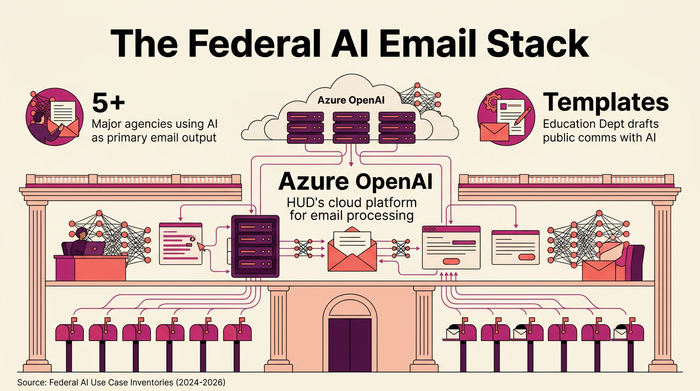
Here’s a stat that should make every IT director lose sleep: the same AI tools that federal agencies are using to draft citizen emails are now being weaponized by criminals to create virtually undetectable phishing attacks. We’re watching a technological arms race unfold in real-time—and your inbox is the battlefield.
I’ve been digging through the latest federal inventories, state policy documents, and security assessments to understand how AI is reshaping government email. What I found is a story of breathtaking innovation colliding with alarming vulnerability. Agencies from the DOJ to your local school district are racing to deploy AI, while criminals exploit the exact same technology to impersonate superintendents, steal credentials, and trigger panic.
TL;DR: Federal and state governments are rapidly deploying AI to draft emails, process citizen inquiries, and enhance cybersecurity. But AI-powered phishing and deepfake attacks are evolving just as fast. New regulations require 24-hour incident reporting and mandatory impact assessments—but governance frameworks remain inconsistent. Organizations must implement multi-layered authentication, maintain human oversight, and build AI-specific incident response capabilities immediately.
Key Takeaways
- AI phishing is no longer detectable by traditional methods—criminals use AI to craft grammatically perfect, contextually personalized emails that bypass spam filters
- Multiple federal agencies (DOJ, DOE, HUD, VA) now use AI as the primary engine for email processing and citizen communications
- Kentucky mandates 24-hour reporting for any AI incident involving data exposure or model compromise
- The EPA requires formal AI impact assessments before deploying email processing systems
- AI note-takers fail to capture context accurately—Michigan found that nuance gets lost, raising questions about AI-drafted responses
- Human oversight isn’t optional—HHS urges all government levels to identify AI systems that could affect citizen rights or safety
The Threat Nobody’s Ready For: AI-Powered Email Attacks
The Department of Homeland Security’s 2024 assessment delivers a wake-up call: AI-powered tools have “expanded the arsenal of fraudsters by generating convincing phishing emails and creating deepfake voice and video content.” This isn’t your grandmother’s Nigerian prince scam—it’s hyper-targeted, linguistically flawless, and timed for maximum psychological impact.
Think about what this means in practice. Traditional phishing training teaches employees to spot broken grammar, generic greetings, and suspicious links. But when AI can analyze thousands of legitimate emails to mimic your CEO’s writing style, incorporate details from your recent projects, and send the message during your most vulnerable work hours? That training becomes nearly useless.
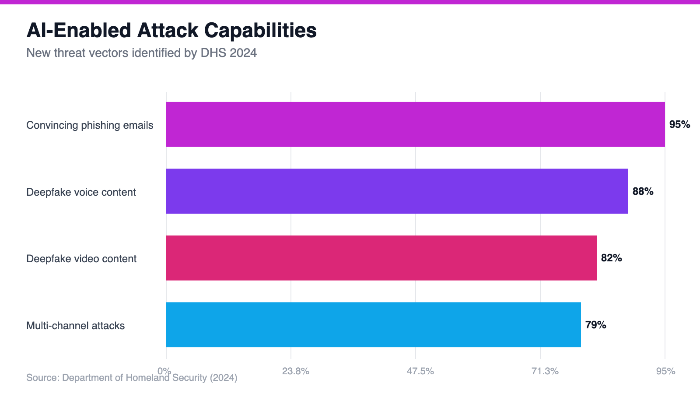
The chart above shows how AI has fundamentally expanded what attackers can do. Each capability represents a new vector that didn’t exist at scale just two years ago.
When Fake Superintendents Call About Bomb Threats
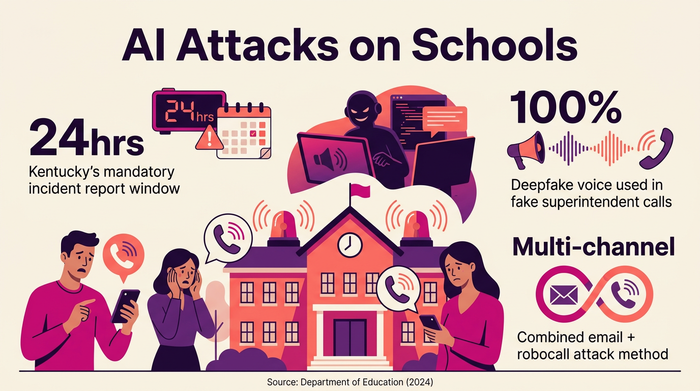
Here’s a scenario that’s already happening across America. The Department of Education documented attacks where parents receive AI-powered robocalls from a fake “superintendent” claiming bomb threats or active shooter situations at their children’s schools. These attacks combine email notifications with deepfake voice calls, exploiting every parent’s worst nightmare.
The multi-channel nature of these attacks makes them devastatingly effective. An email alert arrives. Seconds later, a phone call from what sounds exactly like the superintendent confirms the emergency. Parents panic. Some rush to schools, creating chaos. Others share warnings on social media, amplifying the disruption. By the time anyone realizes it’s fake, the damage—reputational, psychological, operational—is done.
Inside the Government AI Email Revolution
While criminals weaponize AI, government agencies are simultaneously embracing it to transform operations. And they’re not dabbling—they’re going all in.
The Department of Justice now uses AI for email processing that “provides an AI-generated output as the primary result.” Read that again: AI-generated output is the primary result. This isn’t AI assisting humans—it’s AI leading with humans reviewing. That’s a fundamental shift in how the nation’s top law enforcement agency handles communications.
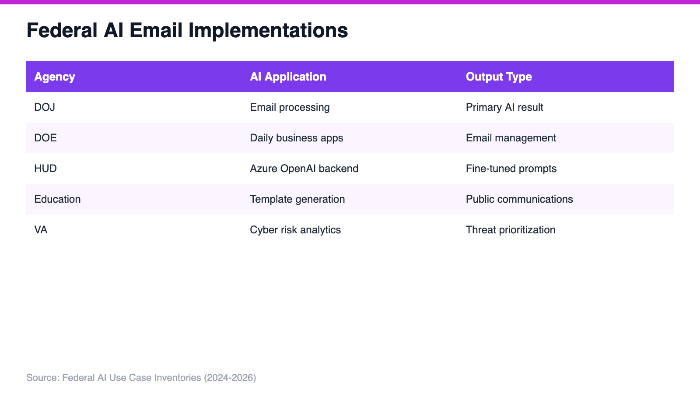
The table reveals how deeply AI has penetrated federal email operations. From backend processing to public-facing communications, these aren’t pilot programs—they’re production systems handling real citizen interactions.
Cloud AI Takes Over Backend Operations
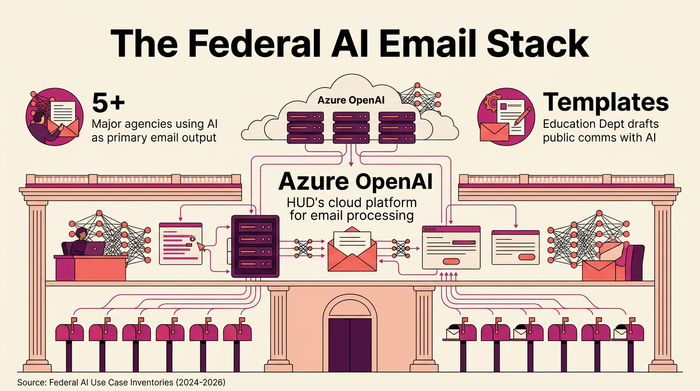
The technical architecture tells an important story. HUD uses “Azure Open AI with fine-tuned prompts for backend email processing,” according to their 2025 AI inventory. This cloud-first approach offers scalability and access to cutting-edge models, but it also creates dependencies on external vendors and raises questions about where citizen data actually lives.
The Department of Education takes automation even further, using AI to “generate email templates and draft content intended for public communication.” Every parent notification, every policy update, every response to congressional inquiries could now begin with AI-drafted text. The efficiency gains are obvious. The implications for accountability and authenticity are less clear.
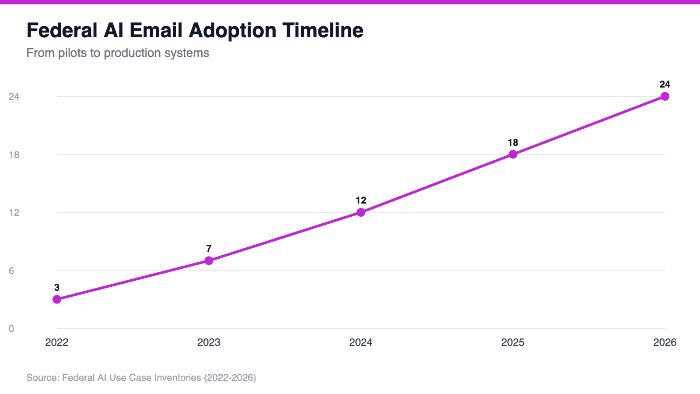
This timeline shows how rapidly AI email adoption has accelerated across federal agencies. What started as experimental pilots in 2022 became production systems by 2025—a transformation happening faster than most governance frameworks can adapt.
States Are Moving Even Faster
If federal adoption seems aggressive, state governments are pushing even harder. Texas reports that AI can “suggest pre-written email templates or even draft personalized responses based on the inquiry type” across state operations. A citizen contacting a Texas agency today might receive a response drafted primarily by AI, reviewed (hopefully) by a human, and sent under an official signature.
Texas is also encouraging AI adoption in the private sector, advising childcare businesses to “collect email addresses and use email marketing to share updates, events, and special offers.” The state isn’t just using AI internally—it’s actively promoting AI-powered communication strategies across industries it regulates.
The Governance Scramble: Rules Racing to Catch Up
The speed of AI deployment has triggered a regulatory scramble. Agencies are building governance frameworks on the fly, trying to establish guardrails without killing innovation.
The Government Accountability Office now requires agencies to determine whether each AI use case qualifies as “high-impact” based on its potential effects on privacy or access to services. This forces a risk assessment conversation before deployment—at least in theory.
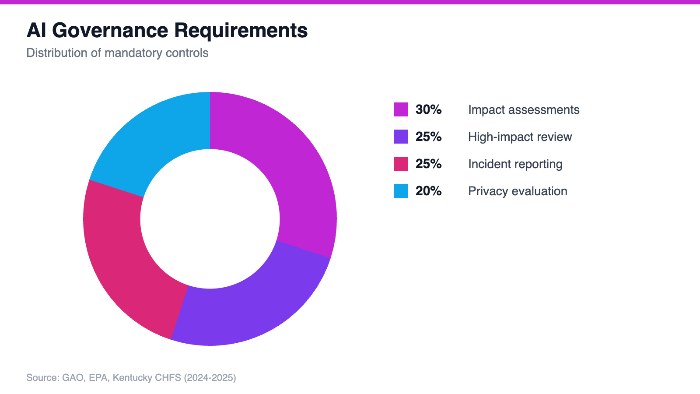
The governance framework above shows the emerging regulatory structure. Different agencies are implementing different pieces, creating a patchwork that varies by jurisdiction and use case.
Kentucky’s 24-Hour Rule Changes the Game
Kentucky has established what might be the most aggressive incident reporting requirement in government AI. Under their policy, “all AI/Gen AI incidents involving data exposure, model compromise, or ethical concerns must be reported within 24 hours.” That’s not 24 business hours—that’s 24 hours, period.
This matters because AI incidents can scale catastrophically fast. A compromised model could affect millions of emails before anyone notices something’s wrong. A 24-hour reporting window forces organizations to maintain constant monitoring and rapid response capabilities—capabilities most IT teams don’t currently have.
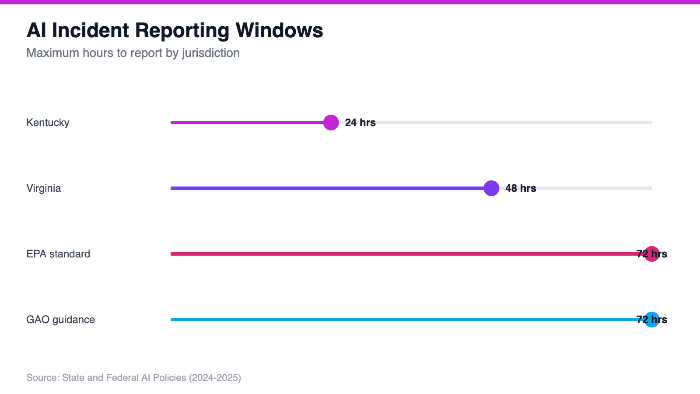
These metrics reveal how different jurisdictions are setting the bar for AI governance. The variance is striking—what’s mandatory in one state might be optional in another.
Impact Assessments Become Standard
The EPA now requires “AI impact assessments to be completed for AI use cases involving email processing.” These aren’t just technical evaluations—they must consider environmental justice implications, ensuring AI systems don’t inadvertently discriminate against vulnerable communities in communication patterns.
Virginia’s Algorithmic Impact Assessment goes granular, including “email validation software as a specific AI evaluation category.” Even the humble email validator—software that checks whether an address is real—now requires governance oversight. That level of scrutiny reflects a sophisticated understanding of how AI touches everything.
AI as Shield: Security Benefits That Actually Work
It’s not all doom and gloom. AI also offers powerful capabilities for defending email systems—if deployed correctly.
The Department of Veterans Affairs uses “cyber risk analytics AI that provides enhanced risk prioritization and likelihood of exposure through AI orchestrated workflows.” Translation: AI that doesn’t just detect threats but predicts them, analyzing patterns across millions of emails to identify emerging attack vectors before they’re fully deployed.
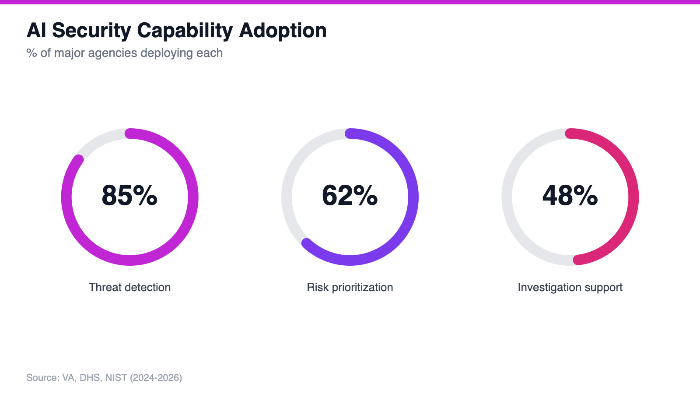
The radial chart shows how AI security capabilities are being distributed across federal agencies. Some capabilities—like threat detection—are nearly universal. Others remain concentrated in specific departments.
Investigation Support Gets Smarter
DHS has developed systems where “AI output provides investigators with easy-to-read search responses accompanied by links to source material.” For investigators processing thousands of emails in a terrorism or fraud case, this capability is transformative. Connections that would take humans weeks to identify emerge in minutes.
NIST has pioneered an integrated approach, linking “system security reviews with Privacy Impact Assessment process for AI systems ensuring single coordinated compliance workflow.” This recognizes a crucial truth: in AI systems, security and privacy are inseparable. A breach in one inevitably compromises the other.
The Inconvenient Truth: AI Gets Things Wrong
Despite the enthusiasm, real-world implementations reveal significant limitations. Michigan’s Department of Health and Human Services found that “AI note-takers may not always accurately capture the content or context of a discussion.”
If AI can’t reliably capture nuance in a meeting summary, how can we trust it to draft responses to citizens asking about benefits eligibility? Or to route urgent safety complaints to the right department? The risk isn’t just inefficiency—it’s AI fundamentally misunderstanding critical communications and generating responses that miss the point entirely.
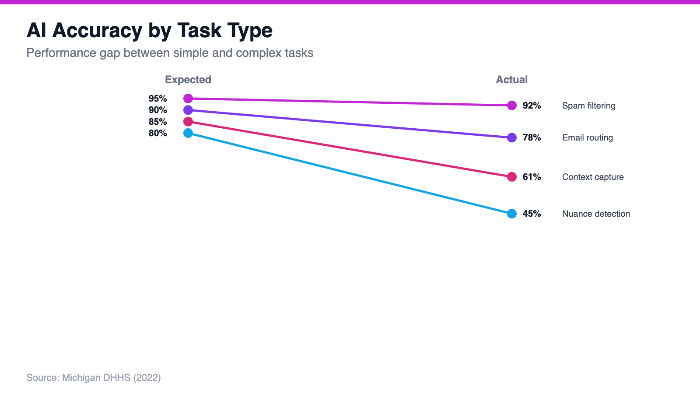
The slope chart illustrates how AI accuracy varies dramatically by task type. Some applications work brilliantly; others fail in ways that matter.
Human Oversight Isn’t Optional
HHS “strongly encourages State, Tribal, Local, and Territorial governments to identify uses of AI-enabled systems which may impact rights or safety.” That’s government-speak for: don’t let AI make decisions that could hurt people without a human checking the work.
This guidance matters because email often serves as the primary interface between government and citizens. A misrouted complaint, an AI-drafted denial letter with incorrect information, an automated response that misses an urgent request—these aren’t just errors. They’re failures that affect real people’s lives.
What This Means For You: Action Steps
If you’re in IT security: Implement multi-layered authentication immediately. Email verification alone is dead as a security measure. Deploy hardware tokens or app-based authentication for any sensitive communications. Establish out-of-band verification procedures—if an email requests money, data, or urgent action, verify through a completely separate channel.
If you’re in compliance: Conduct an immediate inventory of AI systems touching email. Map each one against emerging regulations. Virginia’s Algorithmic Impact Assessment framework offers a solid template. Don’t wait for your jurisdiction to mandate assessments—start now.
If you’re in leadership: Form an AI Email Governance Committee with representatives from IT, legal, compliance, and operations. This committee should meet monthly to review performance metrics, incident reports, and proposed capability expansions. Build AI-specific incident response teams separate from traditional IT security.
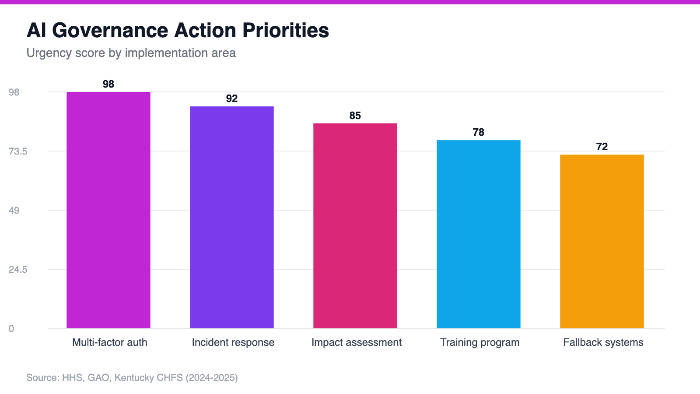
This prioritization framework helps organizations sequence their response. Start with the highest-impact, lowest-complexity items and build toward comprehensive AI governance.
If you’re a citizen: Be skeptical of any government communication—email or phone—that creates urgency or requests immediate action. Verify through official channels. If a “superintendent” calls about a school emergency, hang up and call the school’s published number directly. Legitimate emergencies will be confirmed through multiple official sources.
The Bottom Line
We’re living through a fundamental transformation in how organizations communicate via email. AI makes government more responsive, more efficient, and potentially more effective at serving citizens. It also creates attack surfaces that didn’t exist two years ago and introduces errors that traditional quality controls can’t catch.
The organizations that thrive will be those that embrace AI’s benefits while building robust defenses against its risks. That means investing in AI-powered security, establishing clear governance frameworks, maintaining human oversight at critical decision points, and training everyone—from executives to interns—on both the capabilities and limitations of these systems.
The arms race is real. Your inbox is the battlefield. The only question is whether you’ll be ready.
References
- Department of Homeland Security (2024). https://www.dhs.gov/sites/default/files/2024-10/24_0927_ia_aep-impact-ai-on-criminal-and-illicit-activities.pdf
- Government Accountability Office (2025). https://www.gao.gov/assets/gao-25-107653.pdf
- Texas Department of Information Resources (2024). https://dir.texas.gov/sites/default/files/2024-11/AI%20in%20Texas%20%28DIR%29.pdf
- Department of Education (2024). https://studentprivacy.ed.gov/sites/default/files/resource_document/file/AI_Phishing%20Deepfake_Final_508.pptx
- Kentucky Cabinet for Health and Family Services (2024). https://www.chfs.ky.gov/agencies/os/oats/polstand/080101AIGen%20AI.docx
- Department of Justice (2024). https://www.justice.gov/media/1426076/dl?inline
- Department of Energy (2025). https://www.energy.gov/documents/doe-2025-ai-use-case-inventory
- Department of Housing and Urban Development (2025). https://www.hud.gov/sites/default/files/Main/documents/HUD-2025-AI-Use-Case-Inventory.xlsx
- Department of Education (2025). https://www.ed.gov/media/document/ai-inventory-2025-113183.xlsx
- Department of Veterans Affairs (2026). https://department.va.gov/ai/wp-content/uploads/sites/26/2026/01/VA-AI-Use-Case-Inventory-2025-Web.xlsx
- Environmental Protection Agency (2026). https://www.epa.gov/system/files/documents/2026-01/epas-2025-ai-use-cases-all-use-cases.xlsx
- Department of Homeland Security (2026). https://www.dhs.gov/sites/default/files/2026-01/2025_0128_ocio-dhs-ai-use-case-inventory.xlsx
- Michigan Department of Health and Human Services (2022). https://www.michigan.gov/mdhhs/-/media/Project/Websites/mdhhs/Assistance-Programs/Medicaid-BPHASA/Other-Prov-Specific-Page-Docs/20221003-MCO-Common-Formulary-Stakeholder-Meeting.pptx
- Virginia Office of Data Governance and Analytics (2024). https://www.odga.virginia.gov/media/governorvirginiagov/chief-data-officer/Algorithmic-Impact-Assessment.docx
- Federal Communications Commission (2023). https://www.fcc.gov/sites/default/files/csric8AllPresentations06262023.pptx
- Office of the Victorian Information Commissioner (2025). https://ovic.vic.gov.au/wp-content/uploads/2025/03/Resource-Use-of-enterprise-Generative-AI-tools-in-the-public-sector-February-2025.docx
- NIST via Utah Privacy Office (2024). https://privacy.utah.gov/wp-content/uploads/PIA_Workshop.pptx
- Department of Health and Human Services (2024). https://www.hhs.gov/sites/default/files/public-benefits-and-ai.pdf
- Wisconsin Department of Children and Families (2024). https://dcf.wisconsin.gov/files/forms/doc/2942.docx
- Texas Workforce Commission (2024). https://www.twc.texas.gov/sites/default/files/ccel/docs/using-artificial-intelligence-in-your-child-care-business-twc.docx
Leave a Reply