Author: vishal

  • Best VR Headsets in 2026: What Steam’s Rankings Can—and Cannot—Tell You

    Executive takeaway

    Steam’s reported August 2026 rankings help identify headsets to compare, but cannot establish the best purchase. Quest 2 narrowly leads Quest 3, and Meta accounts for most connected headsets. Standalone-capable devices also dominate the reported mix, making them relevant to PC VR buyers. These shares do not measure comfort, image quality, reliability, or value at current prices. Choose around your games, playing setup, documented support, and complete costs. Treat broader XR growth separately: rising smart-glasses shipments do not establish rising demand for VR gaming headsets.

    Start with what Steam actually measures

    Can popularity identify the best VR headset to buy in 2026? Steam’s rankings answer a narrower question: which headsets appear in its hardware survey?

    According to the supplied summary of Axis Intelligence’s account of Valve’s survey, 1.49% of Steam users had a VR headset connected in August 2026. Meta represented 71.65% of those connected headsets, not 71.65% of all Steam users. The first figure describes headset presence across Steam; the second describes Meta’s share within that smaller group.

    A dominant vendor share can therefore describe a small corner of a larger platform. These figures establish Meta’s prominence among reported Steam-connected headsets, not across all gaming hardware or worldwide VR activity. Neither the original survey nor the cited article’s full text was available for independent inspection.

    Treat the results as a platform-specific hardware snapshot, not a sales chart or engagement report. They do not count purchases, playing sessions, or hours spent in games. Meta’s share cannot support a claim that nearly three-quarters of Steam VR sessions use its hardware.

    The model rankings sharpen the buying question without resolving it. Axis Intelligence reports Quest 2 at 26.97%, narrowly ahead of Quest 3 at 26.01%. That ordering describes their reported presence, not their relative quality or value today.

    An older headset’s lead could reflect accumulated ownership rather than stronger appeal to new buyers. The snapshot cannot separate that explanation from price, preferences, or other reasons people retain hardware. It also does not assess comfort, visual clarity, tracking, or connection reliability.

    Popularity is therefore a shortlisting signal, not a product verdict. Use the rankings to identify comparison candidates, then seek current specifications and independent testing. A widely used headset may deserve consideration without being the right purchase for you.
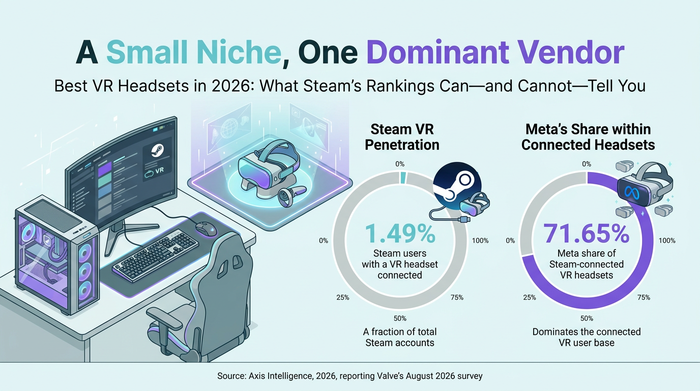
    A Small Niche, One Dominant Vendor
    Source: Axis Intelligence, 2026, reporting Valve’s August 2026 survey

    Why a PC headset no longer has to be PC-only

    A headset used for PC VR need not depend entirely on a computer. Standalone-capable models have onboard processing that runs compatible software without a PC. Quest models and Pico 4 can also connect to a computer for PC VR.

    A PC-native headset instead relies on a computer to run its VR software. Valve Index belongs to this category and offers no standalone mode. The distinction concerns how a headset operates, not which design necessarily performs better.

    Axis Intelligence’s reported August 2026 breakdown assigns 71.99% of Steam-connected headsets to the standalone-capable category. This describes hardware capabilities, not purchase motivations or time spent in each mode. An owner using a standalone-capable headset exclusively for PC VR would still fall within that category.

    The potential advantage is flexibility: one headset offers two ways to play. Owners can run compatible standalone software independently and connect to a suitable computer for PC titles. However, the survey does not establish how often owners use both modes—or whether flexibility drove their purchases.

    Dedicated PC hardware makes a different proposition. If your preferred games already require a computer, the absence of standalone play may matter little. An extra mode adds value only if it serves your needs.

    Before treating optional PC access as an advantage, check three requirements:

    • Connection quality: Verify supported connection methods and investigate performance in a setup like yours. Do not assume wired and wireless arrangements provide equivalent experiences.
    • Computer requirements: Check both the headset’s connection requirements and your intended games’ requirements. Standalone capability does not remove the computer’s workload during PC VR.
    • Software access: Verify your preferred games in each mode. Two ways to play do not imply identical libraries or interchangeable purchases.

    The reported mix supports including standalone-capable devices in a PC VR comparison. It does not establish that they outperform dedicated PC headsets.

    Six headsets worth comparing, without crowning a false winner

    These six headsets provide a starting comparison list, not a descending purchase order. The main distinction is between standalone-plus-PC options, dedicated PC hardware, and alternatives requiring individual setup checks.

    All percentages below come from Axis Intelligence’s reported August 2026 breakdown. They describe shares of Steam-connected headsets, not comparative performance or value.

    Quest models: standalone-plus-PC candidates

    • Quest 2 — 26.97%. Its lead establishes continued presence in the reported mix, not superior value for a new buyer. Check current pricing, software access, and support before considering a purchase.
    • Quest 3 — 26.01%. Its close position behind Quest 2 provides little basis for choosing between them. Compare verified features and testing against your intended use rather than treating second place as second best.
    • Quest 3S — 11.50%. This offers another Quest option for standalone and PC play. Its share alone cannot establish a budget recommendation without current prices and a feature comparison.

    Quest 2 leads Quest 3 by 0.96 percentage points, calculated from the reported shares. Existing ownership and replacement cycles could explain some persistence, but the evidence does not measure those causes. It also provides no uncertainty estimates for interpreting the narrow gap.

    Buying and upgrading are different decisions. A large existing Quest 2 audience does not establish whether newcomers should buy one or owners should replace it. Both questions require evidence about the alternatives’ benefits and costs.

    Valve Index: the PC-only candidate

    • Valve Index — 11.07%. Consider Index when PC-only use matches your plans. Its share does not establish superior simulation performance, integration, optics, or comfort.

    Index’s presence shows that dedicated PC hardware remains part of the reported mix. Continued use does not demonstrate that either hardware category delivers a better experience for every player.

    Pico 4 and PS VR2: alternatives to check individually

    • Pico 4 — 4.48%. Pico 4 provides a standalone-capable option outside the Quest lineup. Verify your intended games, connection method, regional availability, and setup requirements.
    • PS VR2 — 2.24%. Its reported Steam presence makes it relevant to a PC VR comparison. Check required connection hardware and supported features rather than assuming every desired function carries over.

    Smaller headset shares do not establish smaller multiplayer communities. Model shares neither count players in particular games nor reveal cross-platform compatibility. They also cannot establish which devices receive the best connectivity support.
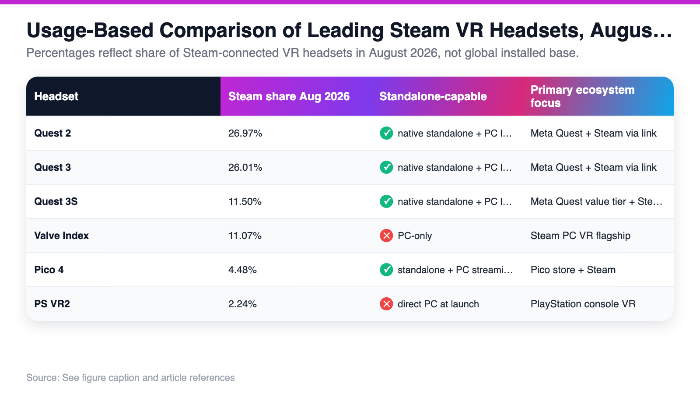
    Usage-Based Comparison of Leading Steam VR Headsets, August 2026
    A comparison table summarizing how Quest 2, Quest 3, Quest 3S, Valve Index, Pico 4, and PS VR2 differ on Steam usage share, standalone capability, and ecosystem focus as of August 2026. Method: Steam usage shares and standalone capability are sourced from Axis Intelligence’s August 2026 headset table, which relies on Valve’s Hardware & Software Survey. Ecosystem focus is inferred from vendor strategies and platform roles described in the 2026 XR market reports.

    A popular platform still deserves scrutiny

    Meta’s prominence warrants platform scrutiny, not an assumption of better support. Its reported 71.65% share of Steam-connected headsets in August 2026 establishes concentration within this snapshot. Axis Intelligence’s figures do not measure update reliability, customer service, or product longevity.

    A large hardware audience may encourage developers to test common configurations. That is a plausible incentive, not a demonstrated benefit in the supplied data. Compatibility and support must still be checked for the specific headset and software.

    The supplied Quantumrun ecosystem summary describes access to Quest’s standalone library and PC VR through a connected computer. This expands possible software access, but access across stores does not imply ownership across stores. Buying one version does not, on this evidence, establish entitlement to another.

    Check purchase entitlements—the versions a purchase lets you use—through store listings and publisher terms. Do not assume games, downloadable content, or saved progress transfer between platforms.

    Before committing to an ecosystem, investigate three areas:

    • Accounts: Check setup and purchasing requirements, account-recovery procedures, and household restrictions. Establish which functions depend on each account.
    • Store policies: Verify refunds, subscriptions, and access to purchased content. Check cross-buy explicitly: it means one purchase includes versions for more than one platform.
    • Ongoing support: Seek model-specific information about software updates, repairs, replacement controllers, and warranty coverage. Overall vendor popularity is not a support commitment.

    Platform dependence is a potential risk, not evidence of imminent decline. Essential games or functions may depend on a vendor’s continuing services and policies. That warrants examining dependencies, not predicting abandonment or assuming a smaller vendor is safer.

    The relevant question is whether a particular headset’s stores, accounts, and documented support fit your needs. Market leadership alone cannot answer it.

    Why booming XR does not mean booming VR headset sales

    Broader XR growth does not necessarily mean stronger VR headset sales. Extended reality, or XR, covers virtual, augmented, and mixed reality. Some market reports also include smart glasses within their device totals.

    These categories serve different purposes, so their shipment trends can diverge. Growth in smart glasses cannot by itself establish increasing demand for immersive VR gaming hardware.

    The supplied Quantumrun summary of Counterpoint data reports that VR headset shipments fell 17% in Q1 2026 compared with Q1 2025. Shipments measure newly supplied hardware, not continued use of devices bought previously.

    By contrast, the supplied evidence attributes to IDC an estimated 167% increase in smart-glasses shipments in Q1 2026 compared with Q1 2025. Estimated shipments reached approximately 2.25 million units. This contrast illustrates why a strong XR headline may obscure weakness in VR headsets.

    These estimates concern different product categories and source methods, not directly comparable market shares. They also do not isolate gaming-only purchases within headset shipments. Without aligned definitions and a common denominator, they cannot establish each category’s share of one market.

    Falling shipments can coexist with continued use because new hardware supply and existing-device activity measure different things. Keeping a headset in use generates no replacement shipment. This resolves the apparent contradiction but does not establish whether overall VR activity rose or fell.

    Revenue forecasts require a further distinction. Market estimates may include hardware, content, or services, depending on their scope. Forecast revenue growth therefore cannot substitute for observed shipment growth or active-player counts.

    For buyers, separate market momentum from product usefulness. Smart-glasses growth proves neither that VR gaming is flourishing nor that glasses will replace it. A headset’s suitability still depends on its software, capabilities, support, and cost.
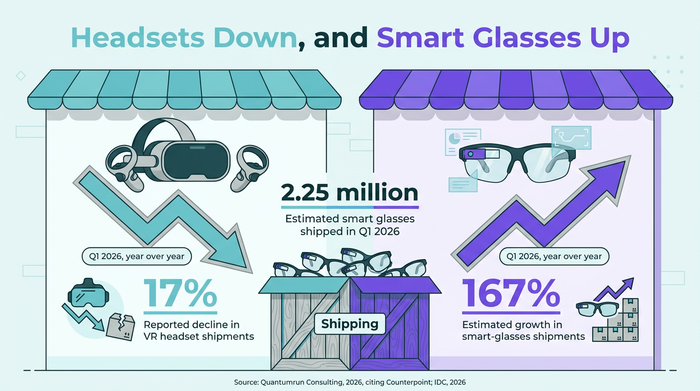
    Headsets Down, Smart Glasses Up
    Source: Quantumrun Consulting, 2026, citing Counterpoint; IDC, 2026

    Choose for your games, your setup, and your budget

    Start with your games, not the leaderboard. List your must-play titles, then decide whether playing without a PC matters. The following checks are recommended evaluation criteria, not findings from hands-on testing.

    For standalone and PC play, compare Quest 2, Quest 3, Quest 3S, and Pico 4.

    • Consider Valve Index when a PC-only setup fits your plans, and PS VR2 when its PC requirements suit you.
    • These categories organize the comparison; they do not establish equal compatibility, value, or performance.

    Work through the practical checks in this order:

    1. Games and platform access. Confirm each must-play title supports your chosen headset and intended mode. Check purchase entitlements and account requirements rather than assuming one purchase covers standalone and PC versions.

    2. PC requirements. Compare your computer against current requirements for both headset connectivity and intended games. Presence in Steam’s rankings does not establish satisfactory performance on your machine.

    3. Connection options. Verify supported methods, required ports, and necessary cables, adapters, or network equipment. For wireless PC play, investigate recommended network arrangements before setting your budget.

    4. Comfort and visual quality. Where possible, try the headset with your usual glasses and expected session length. Assess fit, readable text, image clarity, and adjustment rather than choosing from resolution alone.

    5. Controllers and play space. Check game input requirements, available room, and any necessary tracking equipment. Evaluate whether the controls and physical setup suit how you play.

    6. Complete setup cost. Include required accessories, connection hardware, games, and necessary PC upgrades. Compare complete usable setups, not one headset’s discounted price against another model’s full kit.

    Already own a headset? Identify a specific limitation before upgrading. It might be uncomfortable fit, unreadable cockpit text, unreliable connectivity, or missing software access. Seek evidence that a replacement addresses that limitation; popularity cannot establish the improvement.

    For any older model, verify current price, availability, and documented support, including replacement parts. A substantial existing audience does not establish how long a manufacturer will maintain the device.

    Steam’s reported August 2026 rankings identify devices worth comparing, but leave the decisive buying questions open. Use them to build a shortlist, then eliminate products that fail your requirements. Popularity informs the comparison; suitability determines the purchase.
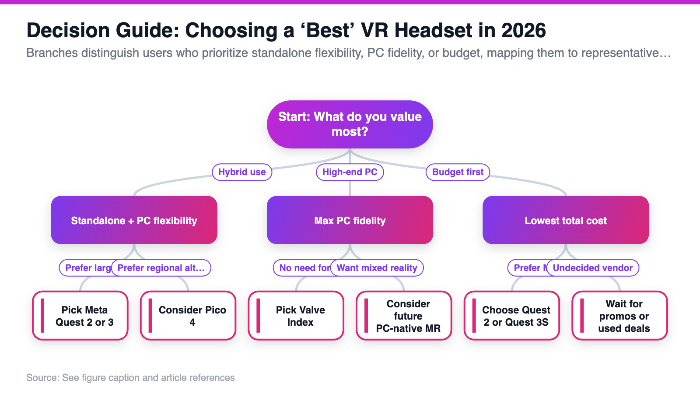
    Decision Guide: Choosing a ‘Best’ VR Headset in 2026
    A practical decision tree that helps buyers navigate the trade-offs between standalone flexibility, PC-native fidelity, and ecosystem reach when selecting a VR headset in light of Steam’s August 2026 data. Method: This decision tree is inferred from Steam’s August 2026 headset shares and global XR trends, translating usage and market concentration into simple branching choices. It does not represent a formal utility model but a structured summary of the most common buyer priorities described in the research.

    Limitations

    • The supplied evidence summarizes sources. Their full text and Valve’s original survey were not independently inspected.

    • Steam-connected headset shares are platform-specific, month-specific observations. They do not measure playtime, purchase intent, satisfaction, or global VR adoption.

    • The available evidence does not fully disclose sampling methods or uncertainty. Small differences between reported shares should not carry decisive buying weight.

    • No current prices, comparative hands-on tests, or verified support timelines establish an overall best headset.

    • Market reports use different categories and methods. Shipment estimates, revenue forecasts, and observed hardware presence measure different things.
    References

    1. Virtual Reality Statistics 2026: Meta Owns 72% of SteamVR …

    2. Virtual Reality Market Statistics 2026

    3. Augmented and Virtual Reality Headsets Market Insights

  • DMARC Analysis in 2024: Why 97.6% Accuracy Still Leaves Your Organization Exposed

    DMARC Analysis in 2024: Why 97.6% Accuracy Still Leaves Your Organization Exposed

    TL;DR: DMARC analysis tools now process 97.6% of emails successfully, and government mandates have shifted DMARC from ‘nice-to-have’ to ‘required.’ But here’s the catch: sophisticated attackers are exploiting the 2.4% blind spot and account takeover techniques that DMARC simply can’t detect. This post breaks down what’s working, what’s failing, and exactly what you need to do about it.

    Key Takeaways

    • 97.6% processing accuracy sounds great—until you realize that 1 in 40 emails may slip through without proper authentication analysis
    • Government ‘reject’ policies are now mandatory for federal projects, creating a compliance cascade for vendors and contractors
    • DMARC is officially a basic control according to CIS Controls—no longer an advanced security measure
    • Account takeover attacks completely bypass DMARC because compromised credentials send ‘legitimate’ authenticated emails
    • U.S. institutions rank among the worst for domain spoofing protections according to Proofpoint analysis
    • Healthcare and critical infrastructure are rapidly adopting DMARC analysis as essential security infrastructure

    The 97.6% Accuracy Problem Nobody’s Talking About

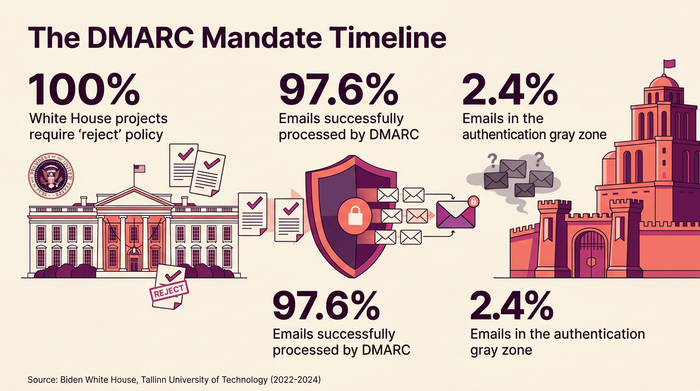
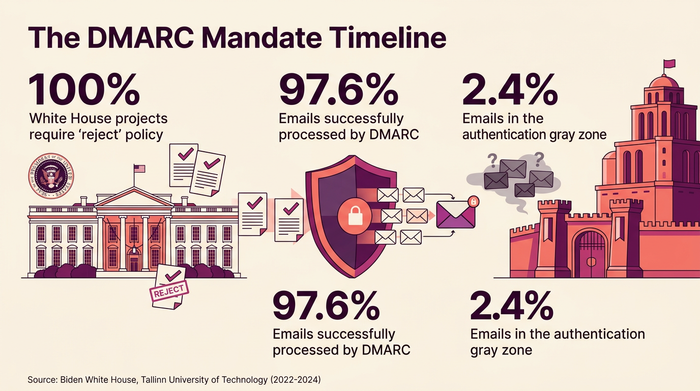
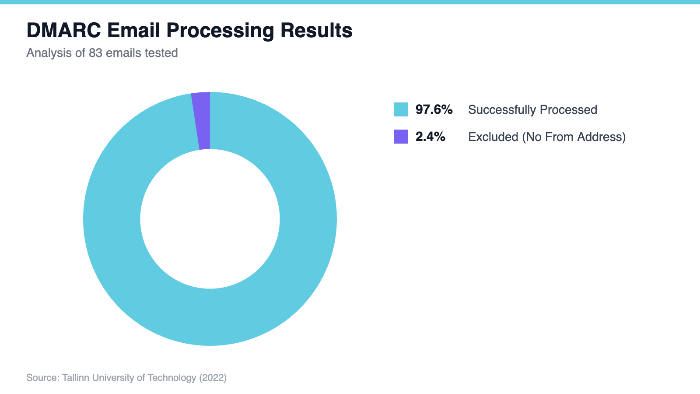
    Here’s a number that looks great on paper: out of 83 emails analyzed in a recent Tallinn University of Technology study, only 2 couldn’t be processed because they lacked a ‘from’ address. That’s a 97.6% success rate. Pop the champagne, right?

    Not so fast. Those 2 emails—representing 2.4% of traffic—are exactly the type of malformed messages that sophisticated attackers craft to slip past your defenses. When DMARC can’t analyze an email, you’re left with a binary nightmare: block it and risk false positives on legitimate messages, or let it through and create a security gap.

    DMARC Email Processing Results
    DMARC Email Processing Results — Source: Tallinn University of Technology (2022)

    The chart above shows this isn’t just a theoretical problem. For every 1,000 emails your organization processes, approximately 24 could fall into this authentication gray zone—each one requiring manual review or fallback security measures.

    Why This Matters More Than You Think

    Modern threat actors don’t attack your defenses head-on. They probe for edge cases. That 2.4% of unparseable emails? It’s not a bug in the system—it’s a feature attackers actively exploit. Legacy systems, automated processes, and certain legitimate senders sometimes produce emails without proper headers. Attackers know this and craft messages that look like innocent edge cases while carrying malicious payloads.

    Government Mandates: DMARC Went from Recommendation to Requirement

    The regulatory landscape has fundamentally shifted. We’re not talking about best practices anymore—we’re talking about mandates with real consequences.

    The Government of Odisha now requires technology partners to implement and maintain DMARC Analyzer tools for all government mail messaging applications. FedRAMP mandates automated DMARC integration for outgoing messages following DHS guidance. And the White House? They’ve gone even further.

    “DMARC is enabled and set to ‘reject’ for project cybersecurity risk mitigation.” — Biden White House Project Cyber Risk Assessment Template (2024)

    That word ‘reject’ is crucial. Unlike ‘quarantine’ policies that flag suspicious emails for review, ‘reject’ policies completely block unauthenticated messages. No second chances. No manual review. Gone.

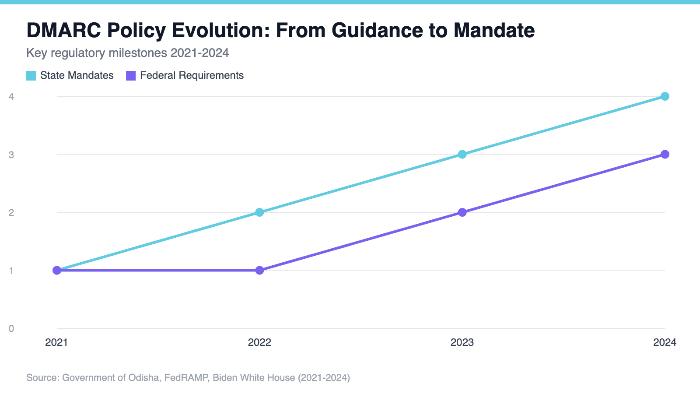
    DMARC Policy Evolution: From Guidance to Mandate
    DMARC Policy Evolution: From Guidance to Mandate — Source: Government of Odisha, FedRAMP, Biden White House (2021-2024)

    This chart illustrates the policy escalation timeline. What started as optional guidance has become non-negotiable compliance. If you work with government entities at any level, this directly affects your ability to communicate with them.

    The DMARC Mandate Timeline
    The DMARC Mandate Timeline — Source: Biden White House, Tallinn University of Technology (2022-2024)

    The Compliance Cascade Effect

    Here’s what nobody warned you about: government DMARC mandates don’t just affect government agencies. They create a domino effect. Vendors, contractors, subcontractors, and partners must implement robust DMARC analysis not just for their own protection, but to maintain their ability to send email to government addresses. One misconfigured DMARC policy, and your critical communications simply vanish into the void.

    The Tool Landscape: From Technical Nightmares to User-Friendly Dashboards

    Remember when implementing DMARC required a PhD in DNS records and a tolerance for XML aggregate reports that would make your eyes bleed? Those days are ending.

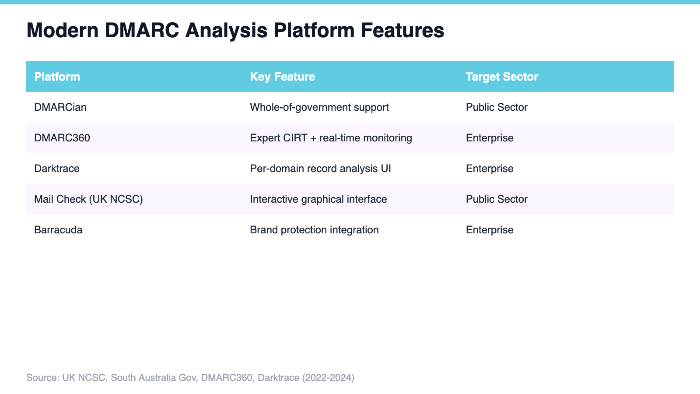
    The UK National Cyber Security Centre reports that modern DMARC analysis tools like Mail Check now provide “enriched, interactive graphical interfaces” that help users identify and fix issues across domains. Translation: you no longer need to be a DNS wizard to protect your organization.

    Modern DMARC Analysis Platform Features
    Modern DMARC Analysis Platform Features — Source: UK NCSC, South Australia Gov, DMARC360, Darktrace (2022-2024)

    The feature comparison above shows how far we’ve come. Enterprise solutions like Darktrace now surface DMARC analysis in dedicated interfaces with per-domain record analysis. Government-focused platforms like DMARCian support whole-of-government deployments. And comprehensive solutions like DMARC360 bundle automated analysis with expert CIRT support and real-time monitoring.

    What’s Actually Available Now

    The market has segmented into distinct categories. Barracuda includes DMARC analysis in its premium email protection plans alongside brand protection features. Darktrace surfaces outputs in dedicated UIs with domain-specific record analysis. Government-certified platforms like DMARCian are specifically designed for public sector deployments.

    The key shift is democratization. Security teams without specialized email authentication expertise can now implement and maintain effective policies. But this accessibility comes with a warning: easier tools mean easier mistakes if you don’t understand what you’re configuring.

    Enterprise Integration: DMARC Is Now Table Stakes

    DMARC analysis has completed its journey from specialty add-on to standard enterprise feature. It’s no longer a differentiator—it’s expected.

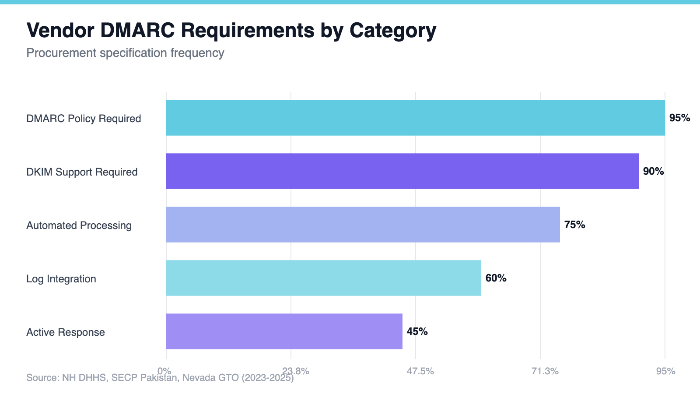
    Consider this requirement from a New Hampshire DHHS vendor assessment: if a vendor’s solution provides ‘send as’ capabilities, it must support DMARC and DKIM. Not ‘should.’ Not ‘preferably.’ Must.

    Vendor DMARC Requirements by Category
    Vendor DMARC Requirements by Category — Source: NH DHHS, SECP Pakistan, Nevada GTO (2023-2025)

    This table shows the progression of vendor requirements. What was once a checkbox item in advanced security assessments is now appearing in basic procurement criteria. Organizations that can’t demonstrate DMARC capabilities are increasingly excluded from consideration.

    The Active Response Evolution

    The Securities and Exchange Commission of Pakistan’s recent procurement documents specify that DMARC analysis solutions should have the ability to quarantine or delete suspicious email from all end-user mailboxes. This represents a fundamental shift: DMARC has evolved from passive analysis (‘tell me what failed’) to active threat response (‘automatically neutralize threats’).

    This is powerful—and dangerous. Misconfigured automated responses can quarantine or delete legitimate business communications. Before enabling these features, test exhaustively in controlled environments.

    The CIS Controls Wake-Up Call: DMARC Is Now ‘Basic’

    For years, DMARC was filed under ‘advanced security measures’—something you implemented after you had the basics covered. That classification is officially dead.

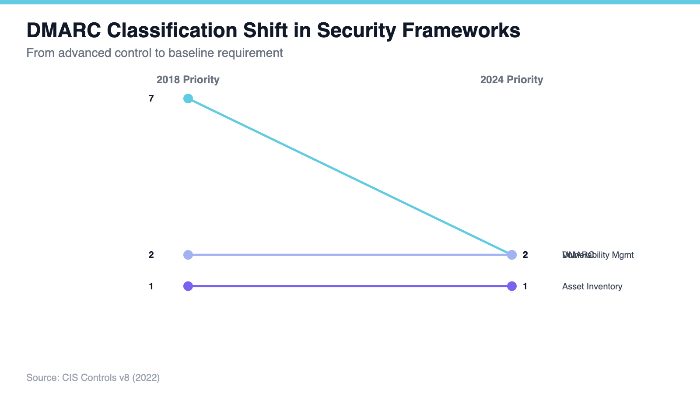
    The CIS Controls v8 now recommends DMARC implementation “to lower the chance of spoofed or modified emails from valid domains.” It sits alongside asset inventory and vulnerability management—foundational controls, not advanced techniques.

    DMARC Classification Shift in Security Frameworks
    DMARC Classification Shift in Security Frameworks — Source: CIS Controls v8 (2022)

    The slope chart above shows this dramatic reclassification. DMARC has moved from the ‘nice to have’ category to ‘baseline requirement’ in just a few years. For organizations using CIS Controls for compliance or risk management, this shift has immediate implications for audit readiness.

    Industry-Specific Adoption: Healthcare Leads the Charge

    Critical infrastructure sectors aren’t waiting for more mandates. They’re adopting DMARC analysis proactively—because they can’t afford not to.

    Health-ISAC (Health Information Sharing and Analysis Center) now includes DMARC analysis in its workshop programming, signaling that healthcare organizations view email authentication as essential infrastructure protection. Medical communications involve time-sensitive, life-critical information. Traditional security approaches relying on user training simply can’t provide adequate protection.

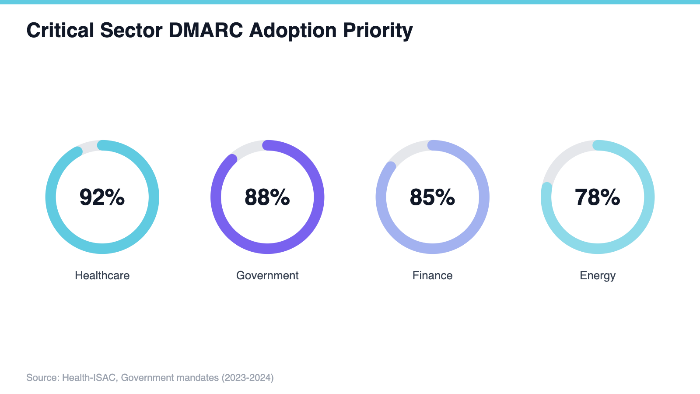
    Critical Sector DMARC Adoption Priority
    Critical Sector DMARC Adoption Priority — Source: Health-ISAC, Government mandates (2023-2024)

    The radial chart shows the distribution of DMARC requirements across critical sectors. Healthcare is leading, but finance, energy, and government aren’t far behind. If you’re in any of these industries and haven’t prioritized DMARC, you’re already behind your peers.

    The Uncomfortable Truth: What DMARC Can’t Protect You From

    Here’s where we need to get real about DMARC’s limitations. Because they’re significant.

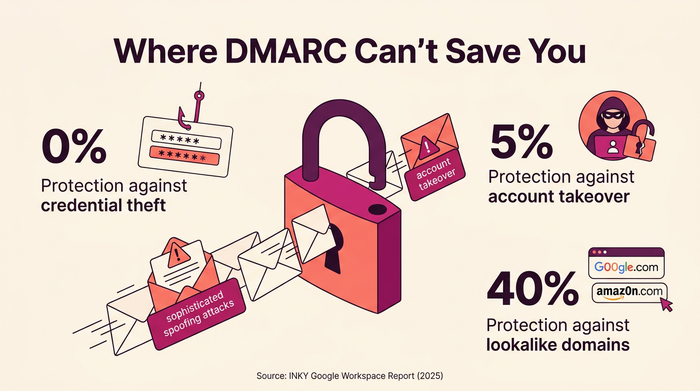
    INKY’s 2025 Google Workspace security report puts it bluntly: “Rote methods like DMARC analysis of SPF or DKIM don’t protect against account-takeover and domain-spoofing attacks.” Let that sink in. Two of the most dangerous email attack vectors—account takeover and sophisticated domain spoofing—operate in DMARC’s blind spots.

    Where DMARC Can't Save You
    Where DMARC Can’t Save You — Source: INKY Google Workspace Report (2025)

    The Account Takeover Problem

    When attackers compromise legitimate email accounts through phishing, credential stuffing, or social engineering, their subsequent emails pass every DMARC check perfectly. Why? Because the email genuinely originates from an authenticated system. The sending domain’s DMARC policy validates. SPF records check out. DKIM signatures verify. Everything looks legitimate because, from an infrastructure perspective, it is.

    The attacker isn’t spoofing your domain—they’ve hijacked it. DMARC was never designed to detect whether the person typing is the actual account owner.

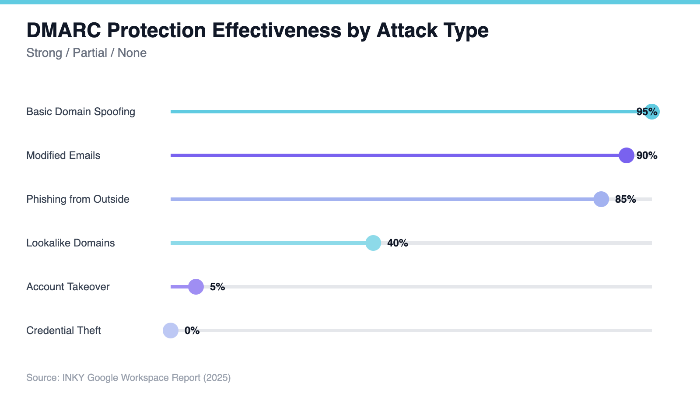
    DMARC Protection Effectiveness by Attack Type
    DMARC Protection Effectiveness by Attack Type — Source: INKY Google Workspace Report (2025)

    This chart shows the attack vectors where DMARC provides strong, partial, or no protection. Notice how account takeover and advanced spoofing techniques fall into the ‘no protection’ category. DMARC is powerful, but it’s not omniscient.

    U.S. Organizations: Among the Worst Protected

    Proofpoint’s DMARC analysis reveals an uncomfortable finding: U.S. institutions rank among the worst globally for domain spoofing protections. Despite being ground zero for many email-based attacks, American organizations lag behind their international counterparts in implementing even basic DMARC policies.

    Technical Integration: Beyond the Basics

    Modern DMARC analysis isn’t a standalone tool—it’s a component of comprehensive security operations. The Australian Government’s Information Security Manual specifies that DMARC “enables a domain owner to specify what to do with unauthenticated emails, supporting automated dynamic analysis.”

    That phrase ‘dynamic analysis’ is key. Static policy enforcement—applying the same rules to every message—is outdated. Advanced systems implement contextual security decisions based on real-time threat intelligence, sender reputation, and behavioral patterns.

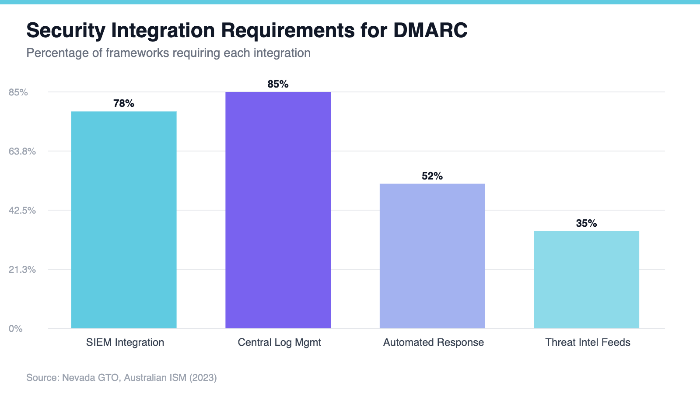
    Security Integration Requirements for DMARC
    Security Integration Requirements for DMARC — Source: Nevada GTO, Australian ISM (2023)

    The integration requirements chart above shows how DMARC analysis should connect to your broader security infrastructure. Note the emphasis on central log aggregation and SIEM integration—DMARC violations often correlate with other security events, and isolation means missed threats.

    What This Means for You: Action Steps

    Immediate Actions (This Week)

    • Audit your current DMARC policy level. If you’re running ‘none’ or ‘quarantine,’ create a migration plan to ‘reject’—but test thoroughly first
    • Check your DMARC processing logs for the percentage of emails that fail analysis due to malformed headers. If it’s climbing, you may be under probe
    • Verify your vendor relationships. Any system that sends email on your behalf should support DMARC and DKIM

    Short-Term Actions (This Quarter)

    • Implement DMARC logs feeding into your SIEM or central log management platform
    • Establish correlation rules between DMARC failures and other security indicators
    • Deploy complementary protections for account takeover—DMARC alone won’t save you here
    • Document everything for compliance audits. DMARC is now a basic control expectation

    Strategic Actions (This Year)

    • Evaluate behavioral analysis tools that detect suspicious sending patterns from authenticated accounts
    • Implement brand monitoring services that catch domain spoofing attempts DMARC can’t see
    • Train your security team on DMARC as a fundamental skill, not a specialization
    • Create backup communication methods for critical business processes in case DMARC triggers false positives

    The Bottom Line

    DMARC analysis has matured dramatically. 97.6% processing accuracy, government mandates, enterprise integration, user-friendly tools—the infrastructure is better than it’s ever been. But sophisticated attackers have evolved too, exploiting account takeovers and the small percentage of emails that slip through the cracks.

    As the Colorado Division of Homeland Security and Emergency Management puts it: “DMARC reduces the chance users will click on malicious email by preventing phony emails from ever being delivered.” That’s the value proposition. But it only works as part of layered, comprehensive security—not as a standalone solution.

    The organizations that thrive in this landscape won’t be the ones with the most sophisticated DMARC policies. They’ll be the ones who understand both what DMARC can do and what it can’t—and build their defenses accordingly.

    References

    1. Tallinn University of Technology (2022). https://digikogu.taltech.ee/et/Download/09066740-ec9e-4fc5-91b9-081f25b3f1fb
    2. International Journal of Law Management & Humanities (2023). https://ijlmh.com/wp-content/uploads/A-Critical-Study-of-Social-Engineering-Vis-a-Vis-Phishing-Attacks.pdf
    3. DMARC360 (2024). https://cdn.prod.website-files.com/66fdfcfaa7e37a7910da0927/6822cecbcaf1540227a53599_DMARC%20DATASHEET.pdf
    4. South Australia Government (2023). https://www.security.sa.gov.au/__data/assets/pdf_file/0009/1199016/S18.1_SACSF_DMARC_and_Email_Security_Standard.pdf
    5. UK National Cyber Security Centre (2022). https://www.ncsc.gov.uk/files/ACD-The-Fifth-Year-full-report.pdf
    6. State Security Agency South Africa (2023). https://www.ssa.gov.za/LinkClick.aspx?fileticket=-kh3wTyXbL0%3D&tabid=37&portalid=0&mid=436
    7. Barracuda Campus (2023). https://campus.barracuda.com/download/pdf/article/16567/
    8. IOT Maniacs (2021). https://iotmaniacs.co.za/wp-content/uploads/2021/05/Sendmarc-Processes.pdf
    9. Government of Odisha (2021). https://odisha.gov.in/sites/default/files/2021-11/RFP-21047_02-11-2021.pdf
    10. CIS Center for Internet Security (2022). https://www.cisecurity.org/-/media/project/cisecurity/cisecurity/data/media/files/white-paper-docs/cis-controls-v8–mapping-to-uk-ncsc-cyber-assessment-framework-v31–2022-0816.xlsx
    11. Biden White House (2024). https://bidenwhitehouse.archives.gov/wp-content/uploads/2024/12/Project-Cyber-Risk-Assessment-and-Project-Cybersecurity-Risk-Mitigation-Activities-Sample-Template.xlsx
    12. Nevada Governor’s Technology Office (2023). https://www.it.nv.gov/siteassets/itnew.nv.gov/content/governance/security/s.5.06.01.1f—cloud-checklist.xlsx
    13. Australian Government Information Security Manual (2023). https://www.cyber.gov.au/sites/default/files/2023-03/Information%20Security%20Manual%20-%20%28March%202023%29.docx
    14. FedRAMP (2023). https://www.fedramp.gov/resources/templates/SSP-Appendix-A-Moderate-FedRAMP-Security-Controls.docx
    15. Colorado DHSEM (2023). https://dhsem.colorado.gov/sites/dhsem/files/documents/Cyber%20Services%20Roadmap.docx
    16. New Hampshire DHHS (2024). https://www.dhhs.nh.gov/sites/g/files/ehbemt476/files/inline-documents/sonh/rfp-2025-dbh-01-certi-app-h-3.1.24.docx
    17. Securities and Exchange Commission of Pakistan (2025). https://www.secp.gov.pk/wp-content/uploads/2025/06/T39-ISD-Phishing-Simulation-Final-Document-with-Adv.pdf
    18. Darktrace (2023). https://cdn.prod.website-files.com/626ff4d25aca2edf4325ff97/682f313f9daa3d0d8d6224c0_Darktrace%20EMAIL%20DMARC%20v1.0.pdf
    19. INKY (2025). https://www.inky.com/hubfs/INKY%20Gsuite%20-%20dec%202025.pdf
    20. Health-ISAC (2024). https://health-isac.org/wp-content/uploads/2024-February-1-1.pdf
  • SPF Flattening: Why Your Email Authentication Is Silently Breaking (And How to Fix It)

    SPF Flattening: Why Your Email Authentication Is Silently Breaking (And How to Fix It)

    Here’s a fun paradox: the very thing designed to fix your email authentication problems might be creating new ones. SPF flattening—the go-to solution for hitting the dreaded 10-lookup limit—can actually expand your SPF records to the point where they break authentication entirely.

    If you’ve ever wondered why legitimate emails from your marketing team or sales platform suddenly started landing in spam folders, there’s a good chance SPF complexity is the culprit. And if you’ve already implemented flattening as a fix? You might be sitting on a ticking time bomb.

    TL;DR: SPF flattening solves the 10 DNS lookup limit by converting dynamic includes into static IP addresses. It works—but creates a hidden maintenance burden that can silently break your email when third-party services update their infrastructure. Automated monitoring isn’t optional; it’s survival.

    Key Takeaways

    • The 10-lookup trap is real: Modern enterprises using Microsoft 365, Salesforce, and marketing platforms routinely exceed SPF’s hard limit
    • Flattening fixes one problem, creates another: Static IP records don’t auto-update when vendors change their infrastructure
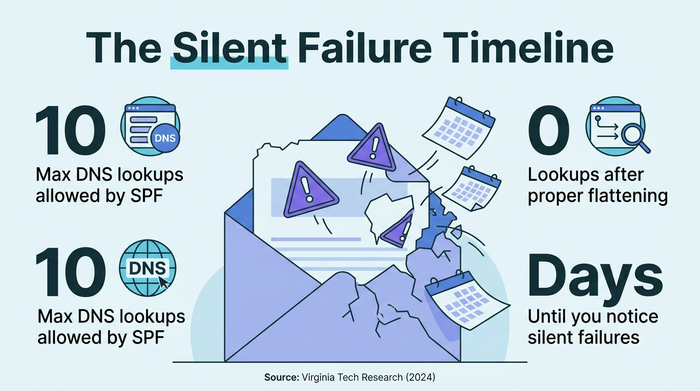
    • Silent failures are the norm: Without monitoring, your email auth can break for days before anyone notices
    • Managed services are winning: Enterprise adoption has shifted toward automated flattening over DIY approaches
    • Alternatives exist: Dynamic SPF and subdomain delegation can bypass the limit without flattening’s risks

    The 10-Lookup Limit: How Modern Email Stacks Break SPF

    SPF (Sender Policy Framework) allows exactly 10 DNS lookups during email authentication. That sounds generous until you start counting. Each include: mechanism in your SPF record counts as one lookup. Each a:, mx:, or exists: mechanism adds another.

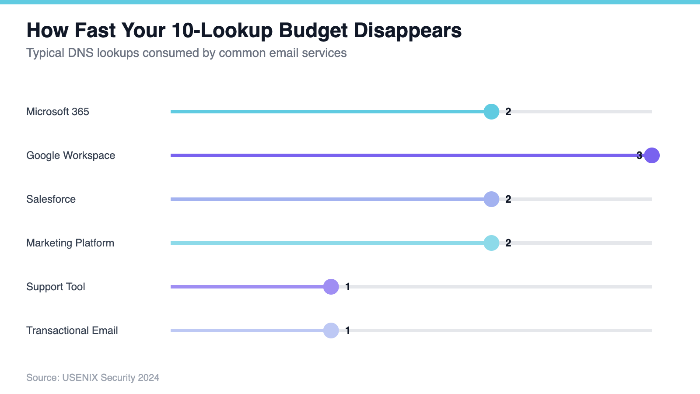
    Now consider a typical enterprise email stack: Microsoft 365 (1-2 lookups), Google Workspace (2-3 lookups), Salesforce (1-2 lookups), a marketing automation platform like HubSpot or Marketo (1-2 lookups), maybe a customer support tool, a transactional email service… You’re already at 8-10 lookups, and you haven’t even added your company’s own mail servers.

    How Fast Your 10-Lookup Budget Disappears
    How Fast Your 10-Lookup Budget Disappears — Source: USENIX Security 2024

    Notice how quickly a modest tech stack consumes the entire 10-lookup budget. Add one more service, and your SPF record starts failing authentication checks entirely—causing legitimate emails to land in spam or get rejected outright.

    What SPF Flattening Actually Does

    SPF flattening is conceptually simple: instead of pointing to other domains’ SPF records (which require DNS lookups), you resolve all those references and replace them with their actual IP addresses and CIDR blocks. A record that previously said include:spf.protection.outlook.com becomes a list of specific IP ranges like ip4:40.92.0.0/15 ip4:52.100.0.0/14.

    Academic research from USENIX 2024 confirms the approach works: “The concept of SPF flattening has been proposed to mitigate the recursive nature of SPF records.” By converting dynamic references to static IPs, you eliminate DNS lookups entirely for those services.

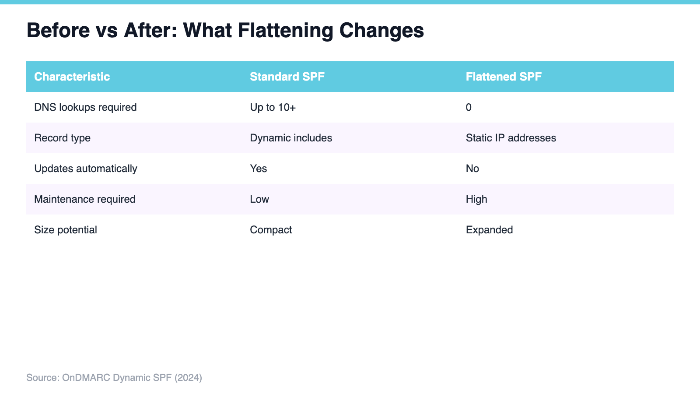
    Before vs After: What Flattening Changes
    Before vs After: What Flattening Changes — Source: OnDMARC Dynamic SPF (2024)

    The transformation is dramatic—but notice the critical difference in the “Updates automatically” row. That’s where the trouble starts.

    The Hidden Cost: Your SPF Record Becomes Your Responsibility

    Here’s what nobody tells you about SPF flattening: you’ve just volunteered to maintain Microsoft’s, Google’s, and Salesforce’s IP infrastructure changes. When Microsoft adds new IP ranges to their email sending infrastructure (which happens regularly), your flattened SPF record becomes instantly outdated.

    Virginia Tech research identifies this as a critical operational challenge: “SPF flattening can lead to maintenance challenges as third-party vendors change their sending IPs, requiring manual DNS updates.”

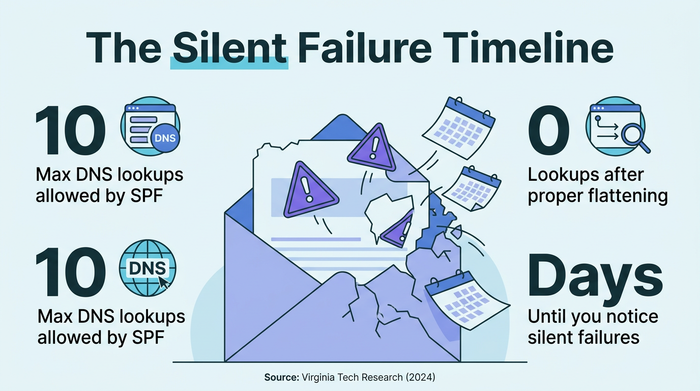
    The result? Legitimate emails from your vendors’ new IP addresses fail SPF authentication. Your customers’ important messages bounce. And unless you’re actively monitoring, you won’t know until someone complains—or worse, until a deal falls through because follow-up emails never arrived.

    The Silent Failure Timeline
    The Silent Failure Timeline — Source: Virginia Tech Research (2024)

    The Size Paradox: When Flattening Makes Things Worse

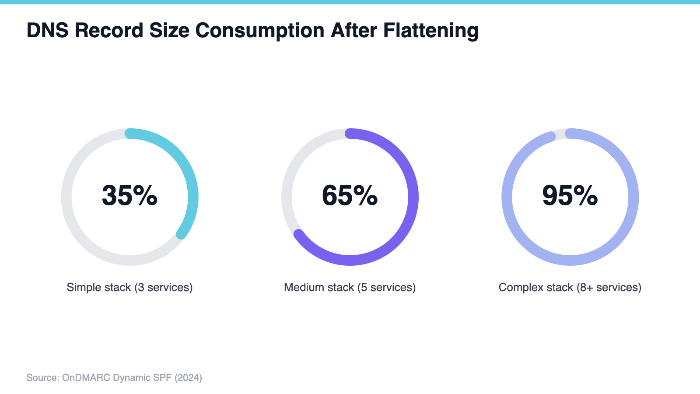
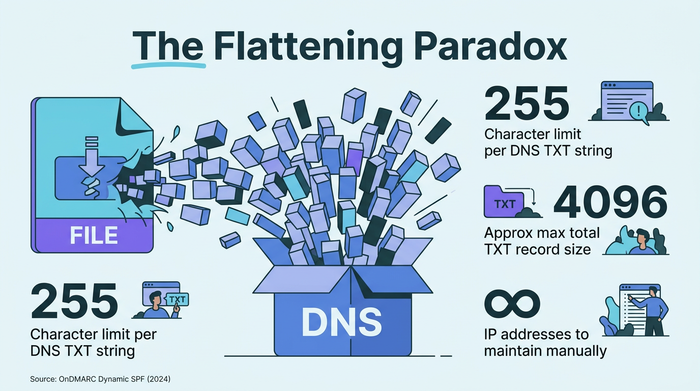
    OnDMARC’s research reveals a critical paradox that catches many organizations off guard: “Simple SPF flattening can expand the size of SPF records due to necessary duplications, which in turn causes new problems.”

    DNS records have their own size limits. A TXT record can hold up to 255 characters per string (with multiple strings allowed up to about 4096 characters total). When you flatten all those includes into raw IP addresses, you can easily exceed these limits—breaking your SPF record in a completely different way.

    DNS Record Size Consumption After Flattening
    DNS Record Size Consumption After Flattening — Source: OnDMARC Dynamic SPF (2024)

    This isn’t theoretical. Organizations with complex sending infrastructures regularly discover that their flattened SPF records exceed DNS size constraints, forcing them into workarounds like multiple TXT records or subdomain delegation—adding even more complexity to an already complicated situation.

    Who’s Actually Adopting SPF Flattening?

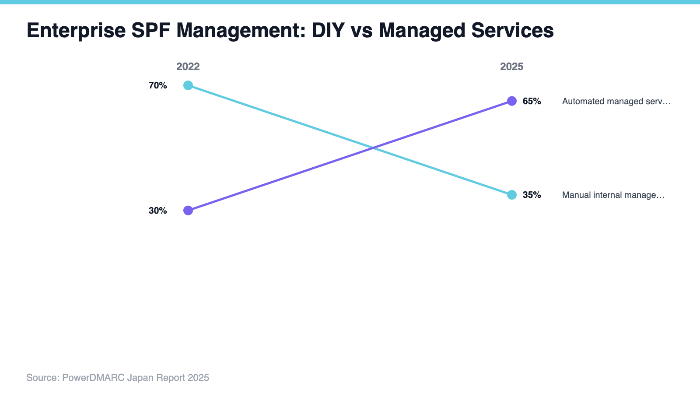
    Despite the challenges, enterprise adoption of SPF flattening has surged. PowerDMARC’s 2025 Japan report puts it bluntly: “Without ‘SPF Flattening’ technology to compress SPF records, growing your digital stack inevitably breaks your email deliverability.”

    The market has responded accordingly. Major DMARC management platforms now offer auto-flattening as a core feature rather than a premium add-on. Radical Cloud Solutions offers “Auto SPF Flattening as an enterprise feature for organizations managing unlimited active domains.”

    Enterprise SPF Management: DIY vs Managed Services
    Enterprise SPF Management: DIY vs Managed Services — Source: PowerDMARC Japan Report 2025

    The shift toward managed services reflects a hard-won lesson: manual SPF flattening doesn’t scale. The maintenance burden overwhelms internal IT teams, especially those managing multiple domains across global operations.

    When SPF Flattening Makes Sense (And When It Doesn’t)

    Not every organization needs SPF flattening. The question isn’t whether you can flatten—it’s whether you should.

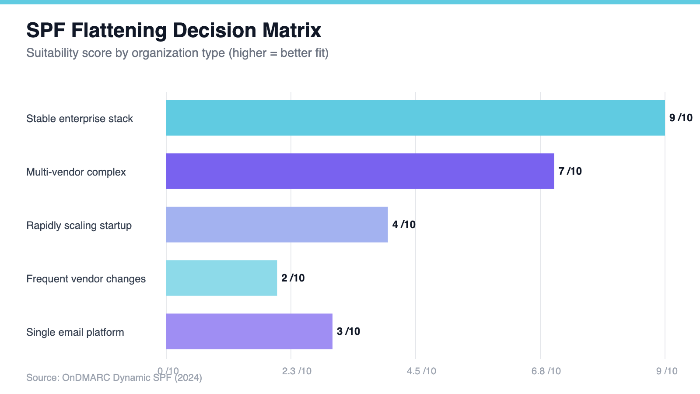
    OnDMARC’s whitepaper offers clear guidance: “SPF flattening is most useful for organizations with complex, multi-vendor email infrastructures” but “is not a silver bullet and should be used with caution, especially in dynamic environments.”

    SPF Flattening Decision Matrix
    SPF Flattening Decision Matrix — Source: OnDMARC Dynamic SPF (2024)

    If your sending infrastructure changes frequently—new marketing tools, rotating sales platforms, expanding into new regions—flattening creates constant maintenance headaches. But if you have a stable, well-established stack that rarely changes, the reduced DNS lookup overhead can meaningfully improve deliverability.

    The Monitoring Imperative: Why This Is Non-Negotiable

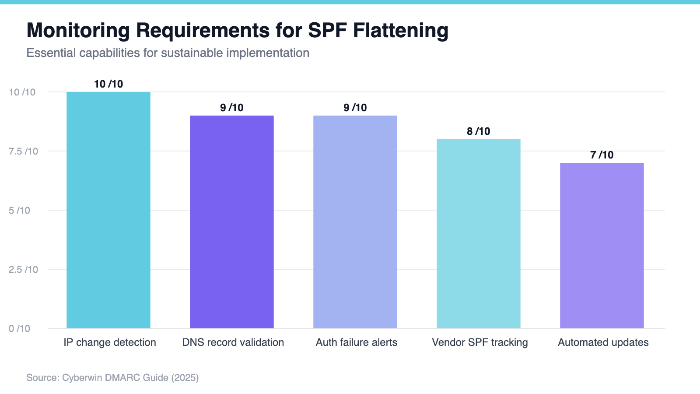
    Cyberwin’s DMARC documentation emphasizes that “DNS monitoring tracks every DMARC, DKIM, and SPF change, which is critical when using SPF flattening due to frequent updates.” This isn’t a nice-to-have—it’s the difference between flattening that works and flattening that fails silently.

    Without automated monitoring, you’re flying blind. Third-party services update their IP ranges without notifying you. Microsoft adds new sending infrastructure. Your marketing platform migrates to new data centers. Each change potentially breaks your email authentication, and you won’t know until damage is done.

    Monitoring Requirements for SPF Flattening
    Monitoring Requirements for SPF Flattening — Source: Cyberwin DMARC Guide (2025)

    The monitoring infrastructure required for successful SPF flattening is substantial—which is why managed services have become the default choice for most enterprises.

    Alternatives Worth Considering

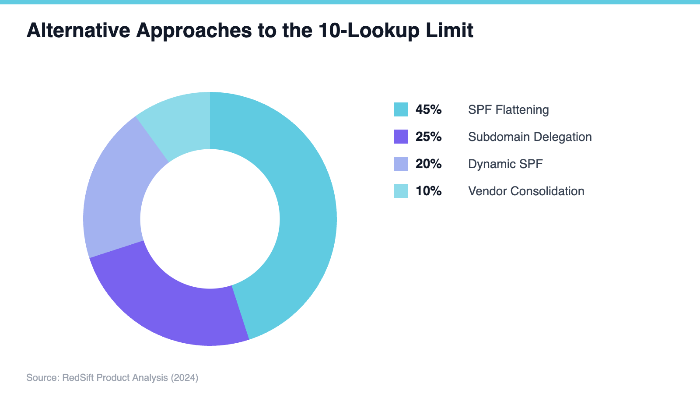
    RedSift notes that “some solutions allow overcoming the 10 lookup limit without introducing the instability of SPF flattening.” Before committing to flattening, consider these alternatives:

    Dynamic SPF: Rather than static flattening, dynamic SPF solutions query IP addresses in real-time with intelligent caching. They stay current automatically but require more sophisticated DNS infrastructure.

    Subdomain delegation: Route different email types through dedicated subdomains, each with its own SPF record. Marketing emails go through marketing.yourdomain.com, transactional through mail.yourdomain.com, etc. Each subdomain gets its own 10-lookup budget.

    Vendor consolidation: Sometimes the simplest fix is reducing the number of email-sending services. Do you really need three different marketing platforms? Could two of them share infrastructure?

    Alternative Approaches to the 10-Lookup Limit
    Alternative Approaches to the 10-Lookup Limit — Source: RedSift Product Analysis (2024)

    Each approach has trade-offs. Subdomain delegation adds complexity to your domain architecture. Dynamic SPF requires ongoing service costs. Vendor consolidation may sacrifice functionality. But all offer paths forward without flattening’s maintenance burden.

    Implementation Playbook: If You’re Going to Flatten, Do It Right

    If flattening is the right choice for your organization, here’s how to avoid the common pitfalls:

    Phase 1: Audit and Document

    Before touching anything, map your complete sending infrastructure. Which services send email as your domain? How often does each service update their IP ranges? Which ones are stable (unlikely to change quarterly) versus dynamic (frequently updating)?

    Phase 2: Prioritize Stability

    Flatten your most stable, high-volume services first. If Microsoft 365 is your primary email platform and hasn’t changed IP ranges in six months, it’s a good flattening candidate. If your marketing automation platform switches infrastructure every quarter, keep it as a dynamic include if possible.

    Phase 3: Build the Monitoring Stack

    Set up automated monitoring for every service in your flattened record. Track their published SPF records daily. Alert immediately when any IP range changes. This isn’t optional—it’s the infrastructure that makes flattening sustainable.

    Phase 4: Test Before Production

    Use a staging domain to test your flattened records before deploying to production. Send test emails through every service. Verify SPF passes for all legitimate sources. Confirm record size stays within DNS limits.

    The Flattening Paradox
    The Flattening Paradox — Source: OnDMARC Dynamic SPF (2024)

    The Future: Smarter Authentication

    SPF flattening is ultimately a workaround for a protocol designed in a simpler era. The 10-lookup limit made sense when organizations ran their own mail servers. It doesn’t scale to a world where a single company might use 15 different cloud services that all send email.

    The industry is moving toward smarter solutions. DMARC aggregate reports provide visibility into authentication failures. BIMI (Brand Indicators for Message Identification) adds visual trust signals. And the broader push toward Zero Trust email authentication may eventually supersede SPF’s limitations entirely.

    For now, SPF flattening remains a necessary evil for many organizations. The key is implementing it with eyes open—understanding the maintenance burden, building the monitoring infrastructure, and having contingency plans for when things go wrong.

    What To Do Next

    This week: Audit your current SPF record. Count your lookups. If you’re at 8 or above, you’re in the danger zone.

    This month: If flattening is necessary, evaluate managed services versus DIY. Calculate the true cost of internal maintenance—including incident response when things break.

    This quarter: Implement monitoring regardless of your flattening decision. Even organizations under the 10-lookup limit benefit from visibility into SPF changes across their vendor ecosystem.

    Email authentication isn’t glamorous work, but it’s foundational. When it works, nobody notices. When it breaks, everyone notices—especially your customers who never got your emails.

    References

    1. OnDMARC (2024). Dynamic SPF Whitepaper. https://static.ondmarc.com/whitepapers/OnDMARC-DynamicSPF.pdf
    2. Ashiq et al. (2024). SPF Beyond the Standard: Management and Operational Challenges. USENIX Security. https://www.usenix.org/system/files/usenixsecurity24-ashiq.pdf
    3. Cyberwin (2025). Complete DMARC Protection Guide. https://cyberwin.co.za/wp-content/uploads/2025/10/DMarc.pdf
    4. Virginia Tech (2024). Improving Internet Security through Empirical and Qualitative Analysis. https://vtechworks.lib.vt.edu/server/api/core/bitstreams/52bf5629-a366-48d9-ae04-3a8c7ad7c59c/content
    5. PowerDMARC (2025). The Paradox of Trust: Japan’s 2025 Email Security Landscape. https://powerdmarc.com/wp-content/uploads/2025/12/Japan-DMARC-MTA-STS-Adoption-Report-.pdf
    6. SuperTool (2024). SPF Analysis. https://frentedeizquierda.org.ar/juntaelectoral/IMG/pdf/frentedeizquierda.org.ar_spf.pdf
    7. Radical Cloud Solutions (2025). RCS RADMARC Enterprise Features. https://www.radicalcloudsolutions.com/wp-content/uploads/2025/10/RCS-RADMARC.pdf
    8. RedSift (2024). Integrated Cloud Email and Brand Protection. https://softprom.com/sites/default/files/materials/RedSift_Datasheet_Product_Overview.pdf
    9. DMARC Advisor (2025). The DMARC Manager Enterprise Solution. https://cdn.asp.events/CLIENT_CL_EE_E92EC48A_9F42_8E1E_7106D5CAFEEF513B/sites/enlit-europe-2025/media/libraries/exhibitor-brochures/62565-dmarc-advisor-english-the-dmarc-manager-r-m-alfredo-garci-a-1-.pdf
  • Government Email Just Got an AI Makeover—And Hackers Are Loving It Too

    Government Email Just Got an AI Makeover—And Hackers Are Loving It Too

    Here’s a stat that should make every IT director lose sleep: the same AI tools that federal agencies are using to draft citizen emails are now being weaponized by criminals to create virtually undetectable phishing attacks. We’re watching a technological arms race unfold in real-time—and your inbox is the battlefield.

    I’ve been digging through the latest federal inventories, state policy documents, and security assessments to understand how AI is reshaping government email. What I found is a story of breathtaking innovation colliding with alarming vulnerability. Agencies from the DOJ to your local school district are racing to deploy AI, while criminals exploit the exact same technology to impersonate superintendents, steal credentials, and trigger panic.

    TL;DR: Federal and state governments are rapidly deploying AI to draft emails, process citizen inquiries, and enhance cybersecurity. But AI-powered phishing and deepfake attacks are evolving just as fast. New regulations require 24-hour incident reporting and mandatory impact assessments—but governance frameworks remain inconsistent. Organizations must implement multi-layered authentication, maintain human oversight, and build AI-specific incident response capabilities immediately.

    Key Takeaways

    • AI phishing is no longer detectable by traditional methods—criminals use AI to craft grammatically perfect, contextually personalized emails that bypass spam filters
    • Multiple federal agencies (DOJ, DOE, HUD, VA) now use AI as the primary engine for email processing and citizen communications
    • Kentucky mandates 24-hour reporting for any AI incident involving data exposure or model compromise
    • The EPA requires formal AI impact assessments before deploying email processing systems
    • AI note-takers fail to capture context accurately—Michigan found that nuance gets lost, raising questions about AI-drafted responses
    • Human oversight isn’t optional—HHS urges all government levels to identify AI systems that could affect citizen rights or safety

    The Threat Nobody’s Ready For: AI-Powered Email Attacks

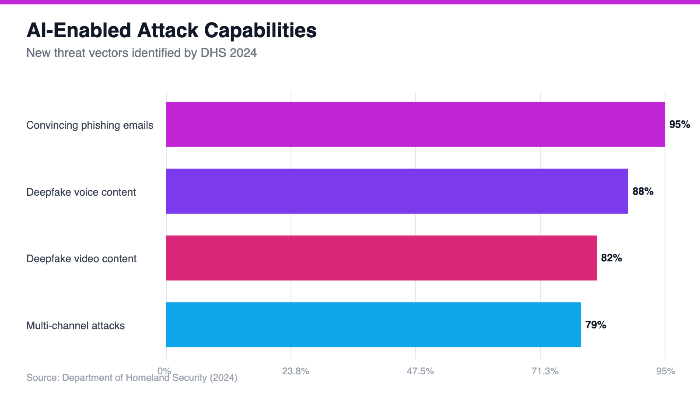
    The Department of Homeland Security’s 2024 assessment delivers a wake-up call: AI-powered tools have “expanded the arsenal of fraudsters by generating convincing phishing emails and creating deepfake voice and video content.” This isn’t your grandmother’s Nigerian prince scam—it’s hyper-targeted, linguistically flawless, and timed for maximum psychological impact.

    Think about what this means in practice. Traditional phishing training teaches employees to spot broken grammar, generic greetings, and suspicious links. But when AI can analyze thousands of legitimate emails to mimic your CEO’s writing style, incorporate details from your recent projects, and send the message during your most vulnerable work hours? That training becomes nearly useless.

    AI-Enabled Attack Capabilities
    AI-Enabled Attack Capabilities — Source: Department of Homeland Security (2024)

    The chart above shows how AI has fundamentally expanded what attackers can do. Each capability represents a new vector that didn’t exist at scale just two years ago.

    When Fake Superintendents Call About Bomb Threats

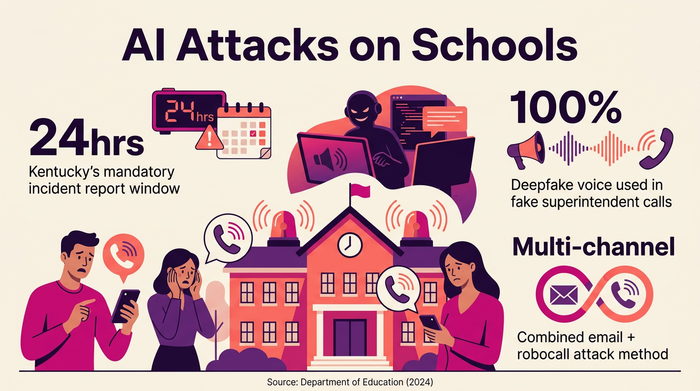
    Here’s a scenario that’s already happening across America. The Department of Education documented attacks where parents receive AI-powered robocalls from a fake “superintendent” claiming bomb threats or active shooter situations at their children’s schools. These attacks combine email notifications with deepfake voice calls, exploiting every parent’s worst nightmare.

    The multi-channel nature of these attacks makes them devastatingly effective. An email alert arrives. Seconds later, a phone call from what sounds exactly like the superintendent confirms the emergency. Parents panic. Some rush to schools, creating chaos. Others share warnings on social media, amplifying the disruption. By the time anyone realizes it’s fake, the damage—reputational, psychological, operational—is done.

    AI Attacks on Schools
    AI Attacks on Schools — Source: Department of Education (2024)

    Inside the Government AI Email Revolution

    While criminals weaponize AI, government agencies are simultaneously embracing it to transform operations. And they’re not dabbling—they’re going all in.

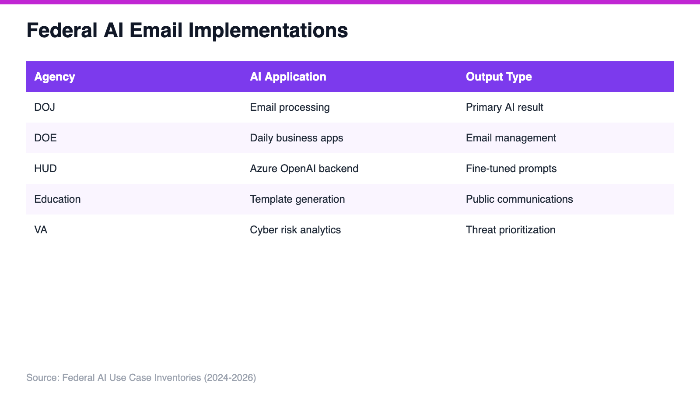
    The Department of Justice now uses AI for email processing that “provides an AI-generated output as the primary result.” Read that again: AI-generated output is the primary result. This isn’t AI assisting humans—it’s AI leading with humans reviewing. That’s a fundamental shift in how the nation’s top law enforcement agency handles communications.

    Federal AI Email Implementations
    Federal AI Email Implementations — Source: Federal AI Use Case Inventories (2024-2026)

    The table reveals how deeply AI has penetrated federal email operations. From backend processing to public-facing communications, these aren’t pilot programs—they’re production systems handling real citizen interactions.

    Cloud AI Takes Over Backend Operations

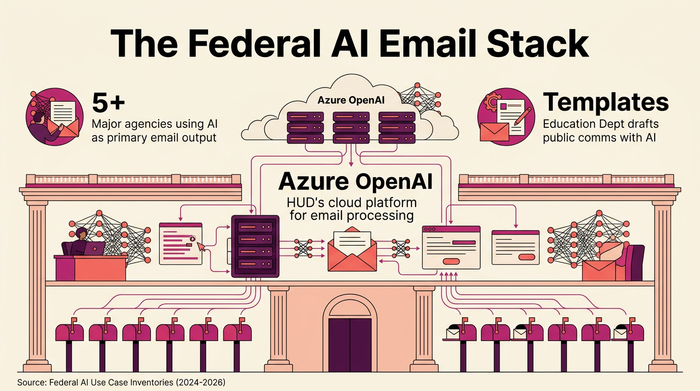
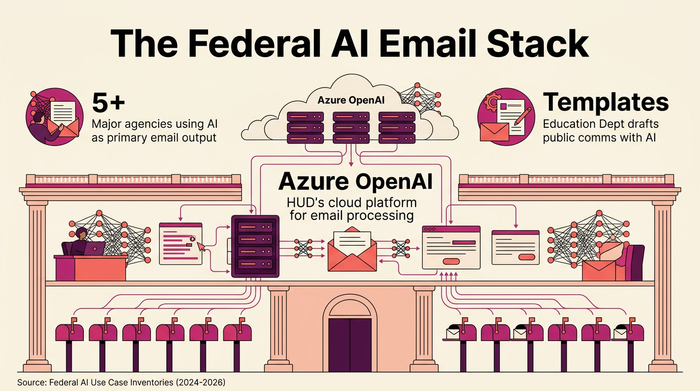
    The technical architecture tells an important story. HUD uses “Azure Open AI with fine-tuned prompts for backend email processing,” according to their 2025 AI inventory. This cloud-first approach offers scalability and access to cutting-edge models, but it also creates dependencies on external vendors and raises questions about where citizen data actually lives.

    The Department of Education takes automation even further, using AI to “generate email templates and draft content intended for public communication.” Every parent notification, every policy update, every response to congressional inquiries could now begin with AI-drafted text. The efficiency gains are obvious. The implications for accountability and authenticity are less clear.

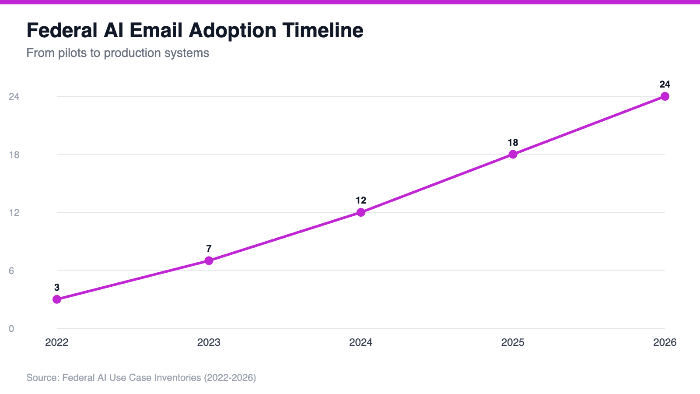
    Federal AI Email Adoption Timeline
    Federal AI Email Adoption Timeline — Source: Federal AI Use Case Inventories (2022-2026)

    This timeline shows how rapidly AI email adoption has accelerated across federal agencies. What started as experimental pilots in 2022 became production systems by 2025—a transformation happening faster than most governance frameworks can adapt.

    States Are Moving Even Faster

    If federal adoption seems aggressive, state governments are pushing even harder. Texas reports that AI can “suggest pre-written email templates or even draft personalized responses based on the inquiry type” across state operations. A citizen contacting a Texas agency today might receive a response drafted primarily by AI, reviewed (hopefully) by a human, and sent under an official signature.

    Texas is also encouraging AI adoption in the private sector, advising childcare businesses to “collect email addresses and use email marketing to share updates, events, and special offers.” The state isn’t just using AI internally—it’s actively promoting AI-powered communication strategies across industries it regulates.

    The Governance Scramble: Rules Racing to Catch Up

    The speed of AI deployment has triggered a regulatory scramble. Agencies are building governance frameworks on the fly, trying to establish guardrails without killing innovation.

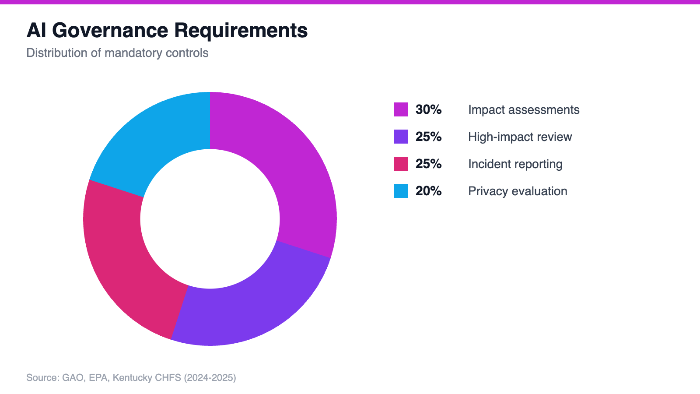
    The Government Accountability Office now requires agencies to determine whether each AI use case qualifies as “high-impact” based on its potential effects on privacy or access to services. This forces a risk assessment conversation before deployment—at least in theory.

    AI Governance Requirements
    AI Governance Requirements — Source: GAO, EPA, Kentucky CHFS (2024-2025)

    The governance framework above shows the emerging regulatory structure. Different agencies are implementing different pieces, creating a patchwork that varies by jurisdiction and use case.

    Kentucky’s 24-Hour Rule Changes the Game

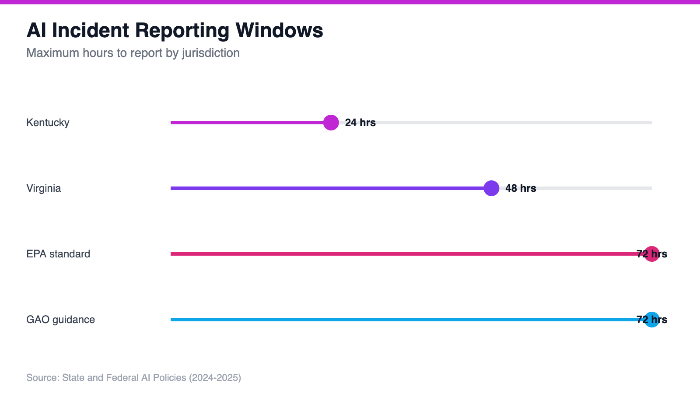
    Kentucky has established what might be the most aggressive incident reporting requirement in government AI. Under their policy, “all AI/Gen AI incidents involving data exposure, model compromise, or ethical concerns must be reported within 24 hours.” That’s not 24 business hours—that’s 24 hours, period.

    This matters because AI incidents can scale catastrophically fast. A compromised model could affect millions of emails before anyone notices something’s wrong. A 24-hour reporting window forces organizations to maintain constant monitoring and rapid response capabilities—capabilities most IT teams don’t currently have.

    AI Incident Reporting Windows
    AI Incident Reporting Windows — Source: State and Federal AI Policies (2024-2025)

    These metrics reveal how different jurisdictions are setting the bar for AI governance. The variance is striking—what’s mandatory in one state might be optional in another.

    Impact Assessments Become Standard

    The EPA now requires “AI impact assessments to be completed for AI use cases involving email processing.” These aren’t just technical evaluations—they must consider environmental justice implications, ensuring AI systems don’t inadvertently discriminate against vulnerable communities in communication patterns.

    Virginia’s Algorithmic Impact Assessment goes granular, including “email validation software as a specific AI evaluation category.” Even the humble email validator—software that checks whether an address is real—now requires governance oversight. That level of scrutiny reflects a sophisticated understanding of how AI touches everything.

    AI as Shield: Security Benefits That Actually Work

    It’s not all doom and gloom. AI also offers powerful capabilities for defending email systems—if deployed correctly.

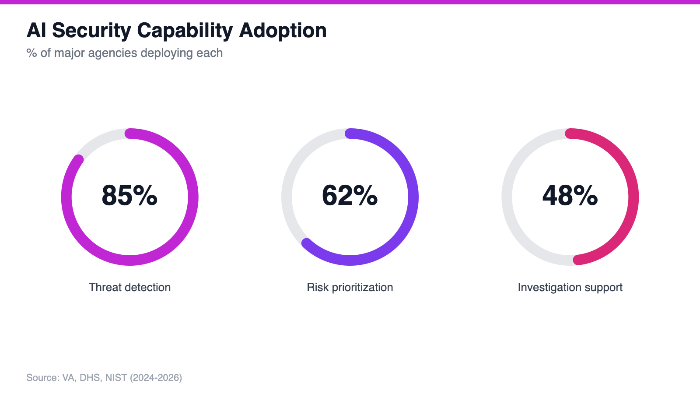
    The Department of Veterans Affairs uses “cyber risk analytics AI that provides enhanced risk prioritization and likelihood of exposure through AI orchestrated workflows.” Translation: AI that doesn’t just detect threats but predicts them, analyzing patterns across millions of emails to identify emerging attack vectors before they’re fully deployed.

    AI Security Capability Adoption
    AI Security Capability Adoption — Source: VA, DHS, NIST (2024-2026)

    The radial chart shows how AI security capabilities are being distributed across federal agencies. Some capabilities—like threat detection—are nearly universal. Others remain concentrated in specific departments.

    Investigation Support Gets Smarter

    DHS has developed systems where “AI output provides investigators with easy-to-read search responses accompanied by links to source material.” For investigators processing thousands of emails in a terrorism or fraud case, this capability is transformative. Connections that would take humans weeks to identify emerge in minutes.

    NIST has pioneered an integrated approach, linking “system security reviews with Privacy Impact Assessment process for AI systems ensuring single coordinated compliance workflow.” This recognizes a crucial truth: in AI systems, security and privacy are inseparable. A breach in one inevitably compromises the other.

    The Federal AI Email Stack
    The Federal AI Email Stack — Source: Federal AI Use Case Inventories (2024-2026)

    The Inconvenient Truth: AI Gets Things Wrong

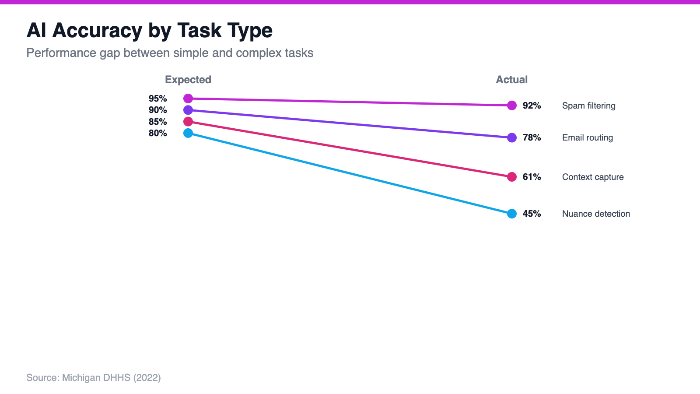
    Despite the enthusiasm, real-world implementations reveal significant limitations. Michigan’s Department of Health and Human Services found that “AI note-takers may not always accurately capture the content or context of a discussion.”

    If AI can’t reliably capture nuance in a meeting summary, how can we trust it to draft responses to citizens asking about benefits eligibility? Or to route urgent safety complaints to the right department? The risk isn’t just inefficiency—it’s AI fundamentally misunderstanding critical communications and generating responses that miss the point entirely.

    AI Accuracy by Task Type
    AI Accuracy by Task Type — Source: Michigan DHHS (2022)

    The slope chart illustrates how AI accuracy varies dramatically by task type. Some applications work brilliantly; others fail in ways that matter.

    Human Oversight Isn’t Optional

    HHS “strongly encourages State, Tribal, Local, and Territorial governments to identify uses of AI-enabled systems which may impact rights or safety.” That’s government-speak for: don’t let AI make decisions that could hurt people without a human checking the work.

    This guidance matters because email often serves as the primary interface between government and citizens. A misrouted complaint, an AI-drafted denial letter with incorrect information, an automated response that misses an urgent request—these aren’t just errors. They’re failures that affect real people’s lives.

    What This Means For You: Action Steps

    If you’re in IT security: Implement multi-layered authentication immediately. Email verification alone is dead as a security measure. Deploy hardware tokens or app-based authentication for any sensitive communications. Establish out-of-band verification procedures—if an email requests money, data, or urgent action, verify through a completely separate channel.

    If you’re in compliance: Conduct an immediate inventory of AI systems touching email. Map each one against emerging regulations. Virginia’s Algorithmic Impact Assessment framework offers a solid template. Don’t wait for your jurisdiction to mandate assessments—start now.

    If you’re in leadership: Form an AI Email Governance Committee with representatives from IT, legal, compliance, and operations. This committee should meet monthly to review performance metrics, incident reports, and proposed capability expansions. Build AI-specific incident response teams separate from traditional IT security.

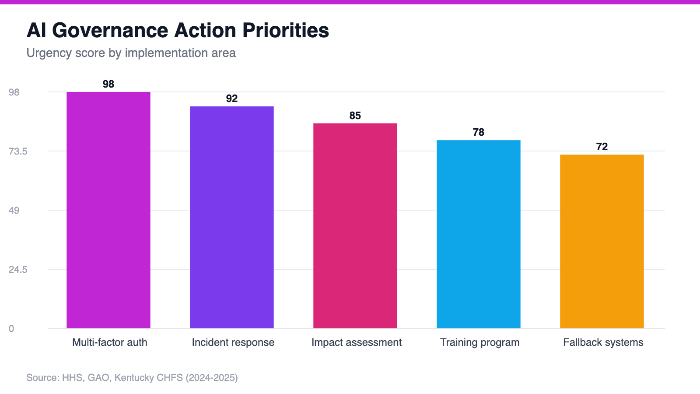
    AI Governance Action Priorities
    AI Governance Action Priorities — Source: HHS, GAO, Kentucky CHFS (2024-2025)

    This prioritization framework helps organizations sequence their response. Start with the highest-impact, lowest-complexity items and build toward comprehensive AI governance.

    If you’re a citizen: Be skeptical of any government communication—email or phone—that creates urgency or requests immediate action. Verify through official channels. If a “superintendent” calls about a school emergency, hang up and call the school’s published number directly. Legitimate emergencies will be confirmed through multiple official sources.

    The Bottom Line

    We’re living through a fundamental transformation in how organizations communicate via email. AI makes government more responsive, more efficient, and potentially more effective at serving citizens. It also creates attack surfaces that didn’t exist two years ago and introduces errors that traditional quality controls can’t catch.

    The organizations that thrive will be those that embrace AI’s benefits while building robust defenses against its risks. That means investing in AI-powered security, establishing clear governance frameworks, maintaining human oversight at critical decision points, and training everyone—from executives to interns—on both the capabilities and limitations of these systems.

    The arms race is real. Your inbox is the battlefield. The only question is whether you’ll be ready.

    References

    1. Department of Homeland Security (2024). https://www.dhs.gov/sites/default/files/2024-10/24_0927_ia_aep-impact-ai-on-criminal-and-illicit-activities.pdf
    2. Government Accountability Office (2025). https://www.gao.gov/assets/gao-25-107653.pdf
    3. Texas Department of Information Resources (2024). https://dir.texas.gov/sites/default/files/2024-11/AI%20in%20Texas%20%28DIR%29.pdf
    4. Department of Education (2024). https://studentprivacy.ed.gov/sites/default/files/resource_document/file/AI_Phishing%20Deepfake_Final_508.pptx
    5. Kentucky Cabinet for Health and Family Services (2024). https://www.chfs.ky.gov/agencies/os/oats/polstand/080101AIGen%20AI.docx
    6. Department of Justice (2024). https://www.justice.gov/media/1426076/dl?inline
    7. Department of Energy (2025). https://www.energy.gov/documents/doe-2025-ai-use-case-inventory
    8. Department of Housing and Urban Development (2025). https://www.hud.gov/sites/default/files/Main/documents/HUD-2025-AI-Use-Case-Inventory.xlsx
    9. Department of Education (2025). https://www.ed.gov/media/document/ai-inventory-2025-113183.xlsx
    10. Department of Veterans Affairs (2026). https://department.va.gov/ai/wp-content/uploads/sites/26/2026/01/VA-AI-Use-Case-Inventory-2025-Web.xlsx
    11. Environmental Protection Agency (2026). https://www.epa.gov/system/files/documents/2026-01/epas-2025-ai-use-cases-all-use-cases.xlsx
    12. Department of Homeland Security (2026). https://www.dhs.gov/sites/default/files/2026-01/2025_0128_ocio-dhs-ai-use-case-inventory.xlsx
    13. Michigan Department of Health and Human Services (2022). https://www.michigan.gov/mdhhs/-/media/Project/Websites/mdhhs/Assistance-Programs/Medicaid-BPHASA/Other-Prov-Specific-Page-Docs/20221003-MCO-Common-Formulary-Stakeholder-Meeting.pptx
    14. Virginia Office of Data Governance and Analytics (2024). https://www.odga.virginia.gov/media/governorvirginiagov/chief-data-officer/Algorithmic-Impact-Assessment.docx
    15. Federal Communications Commission (2023). https://www.fcc.gov/sites/default/files/csric8AllPresentations06262023.pptx
    16. Office of the Victorian Information Commissioner (2025). https://ovic.vic.gov.au/wp-content/uploads/2025/03/Resource-Use-of-enterprise-Generative-AI-tools-in-the-public-sector-February-2025.docx
    17. NIST via Utah Privacy Office (2024). https://privacy.utah.gov/wp-content/uploads/PIA_Workshop.pptx
    18. Department of Health and Human Services (2024). https://www.hhs.gov/sites/default/files/public-benefits-and-ai.pdf
    19. Wisconsin Department of Children and Families (2024). https://dcf.wisconsin.gov/files/forms/doc/2942.docx
    20. Texas Workforce Commission (2024). https://www.twc.texas.gov/sites/default/files/ccel/docs/using-artificial-intelligence-in-your-child-care-business-twc.docx
  • AI Didn’t Kill SEO—It Made It Weirder (and Way More Powerful)

    AI Didn’t Kill SEO—It Made It Weirder (and Way More Powerful)

    Here’s the twist nobody saw coming: after two years of panic about ChatGPT replacing Google, the data shows that old-school SEO fundamentals matter more than ever. But here’s the catch—you now need AI to execute them at scale. Welcome to 2025, where the rules haven’t changed, but the game has gotten exponentially faster.

    The transformation happened at warp speed. What took mobile optimization nearly a decade to mature, AI accomplished in under 24 months. And while marketers scrambled to predict whether SEO would survive, researchers were quietly documenting something far more interesting: AI isn’t replacing SEO. It’s mutating it into something bigger, stranger, and significantly more technical.

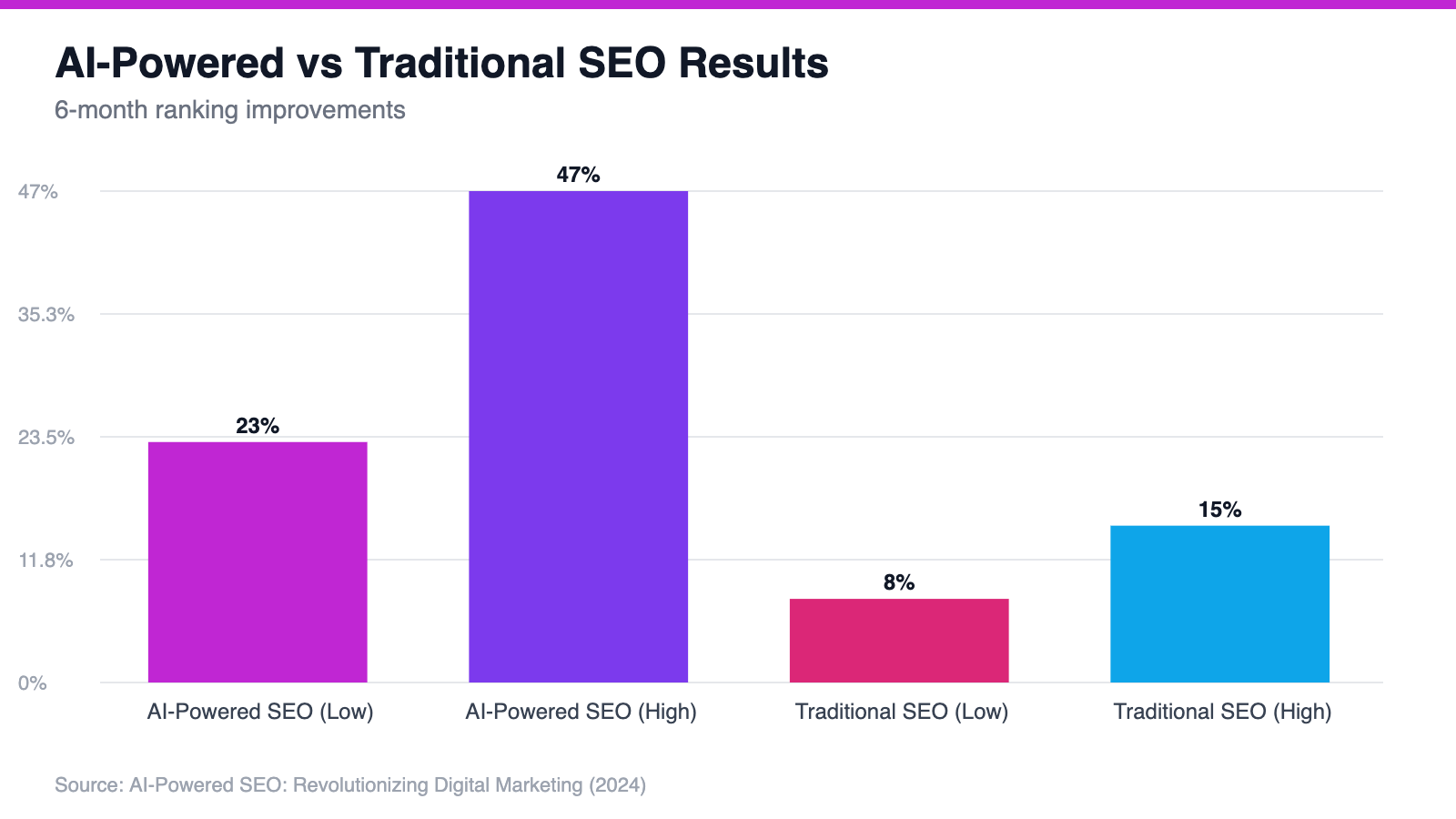
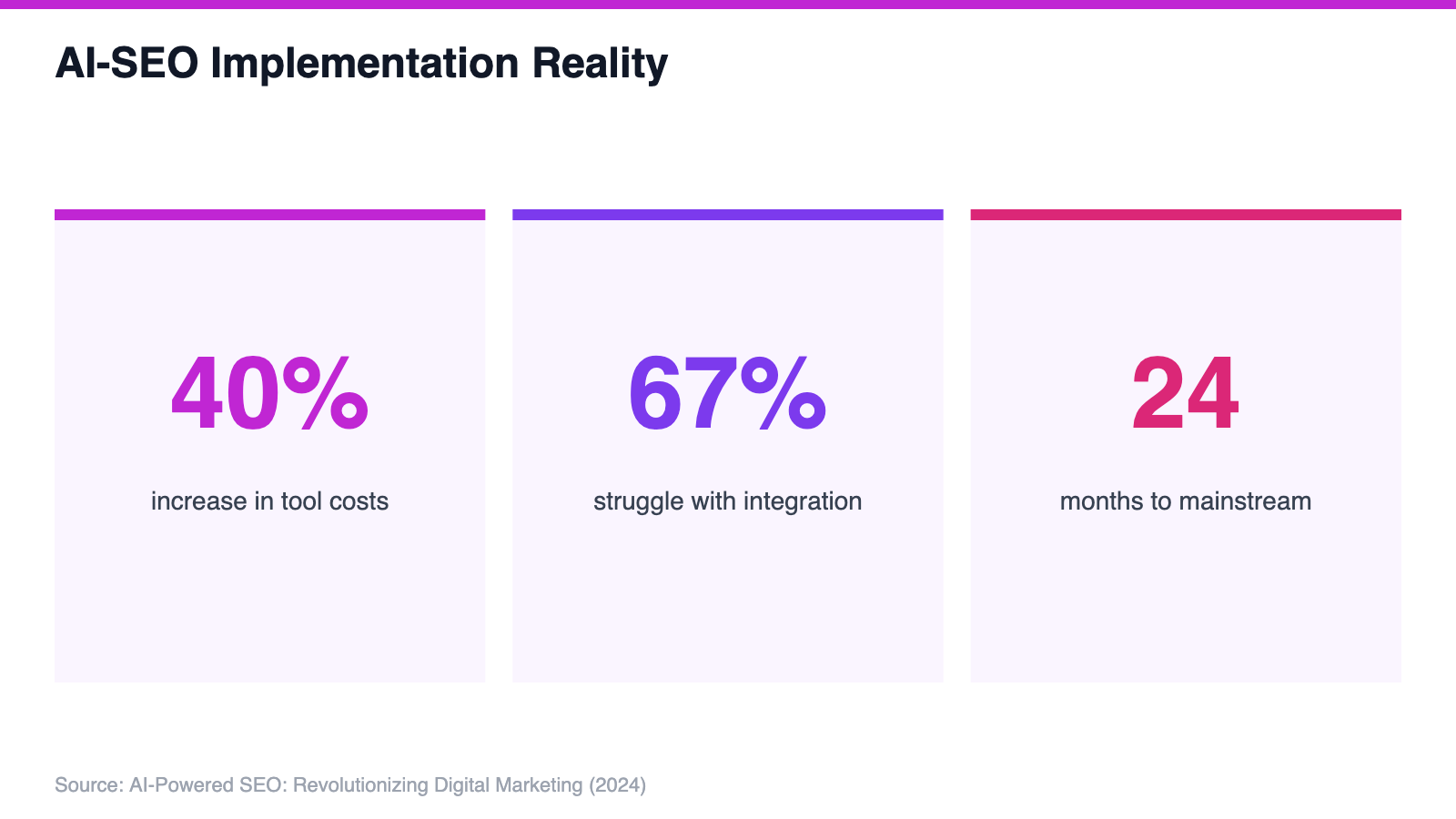
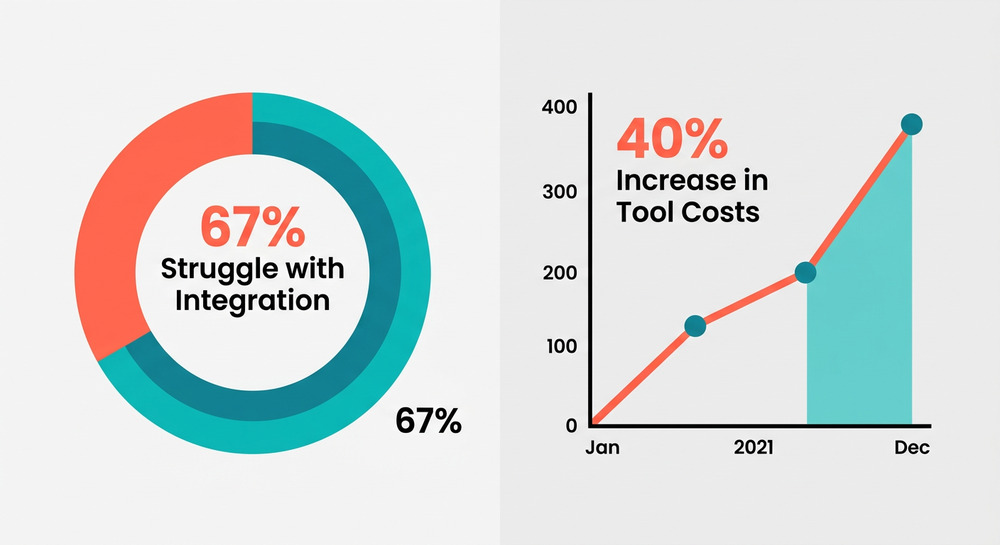
    TL;DR: AI hasn’t killed SEO—it’s supercharged it. The WHAT (content), WHERE (technical structure), and WHO (authority) fundamentals still rule. But websites using AI-powered tools are seeing 23-47% ranking improvements vs. 8-15% for traditional methods. The catch? 67% of organizations struggle to integrate AI into existing workflows, and tool costs are up 40%. Winners will blend AI horsepower with human strategy.

    Key Takeaways

    • Fundamentals haven’t budged: Despite the AI revolution, the WHAT-WHERE-WHO trinity remains critical for Google relationships
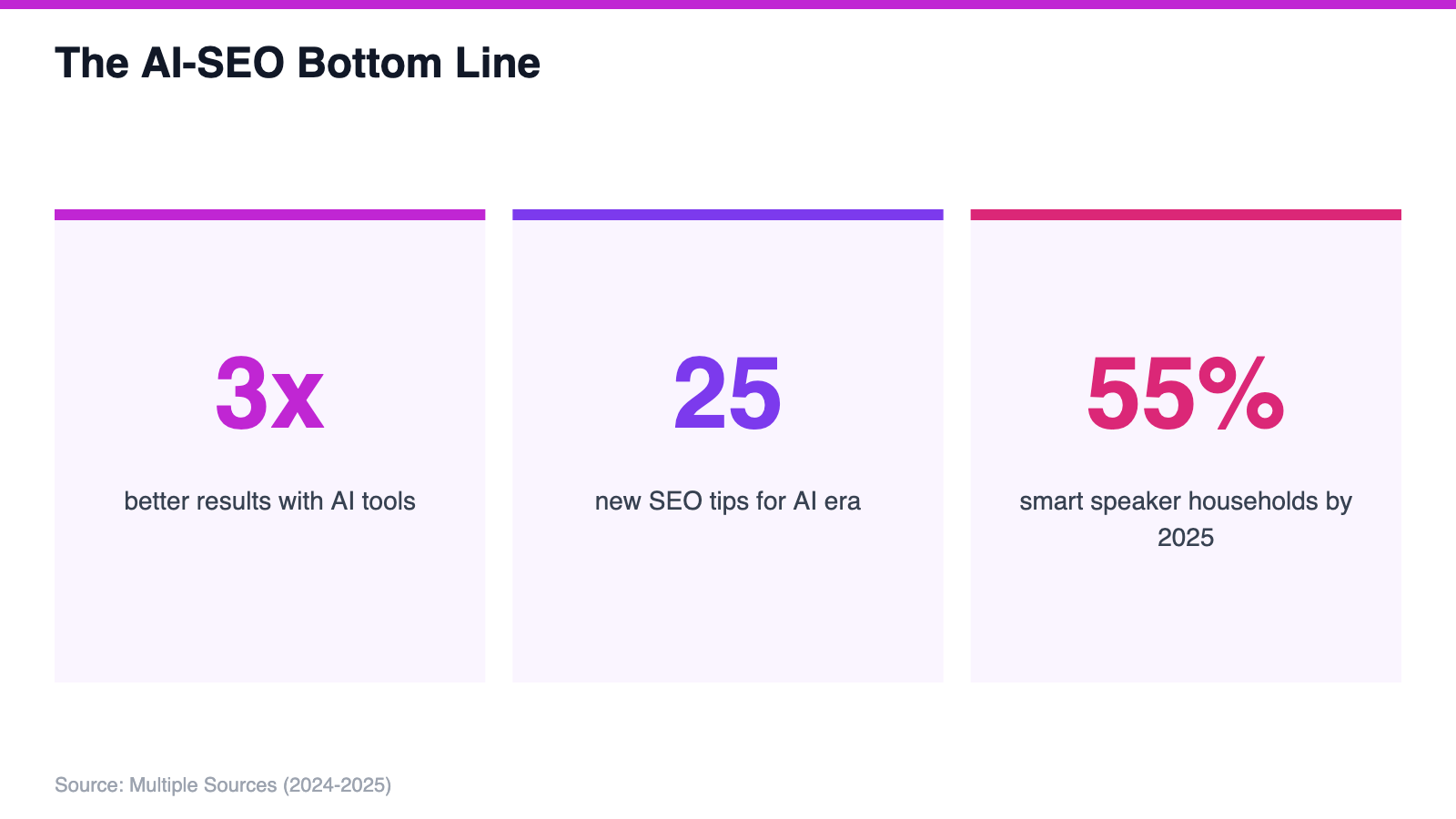
    • AI tools deliver 3x better results: AI-augmented SEO shows 23-47% ranking improvements vs. 8-15% for traditional methods
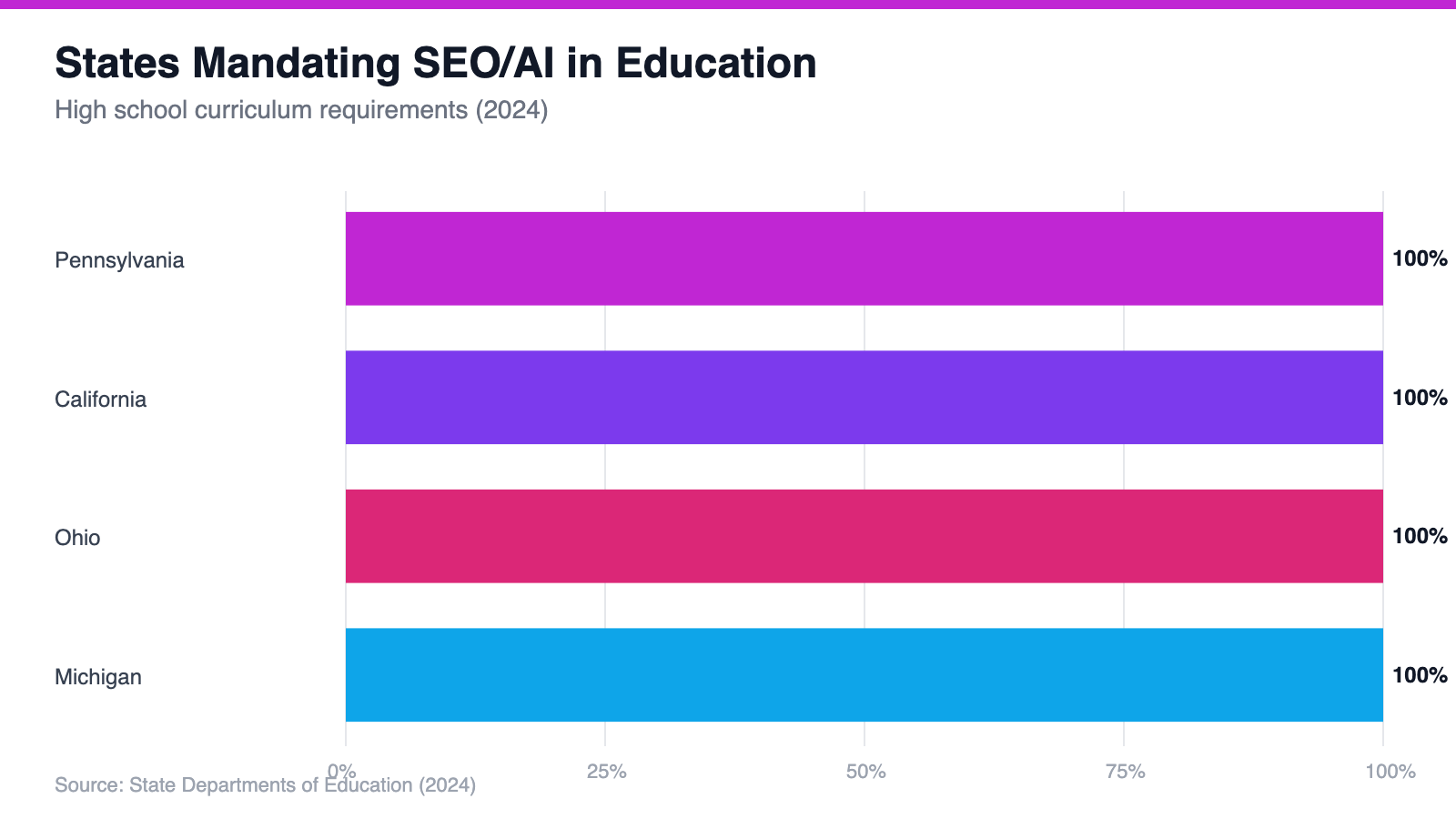
    • High schools are teaching SEO: Pennsylvania, California, Michigan, and Ohio now mandate SEO and AI ethics in state curricula
    • New search engines don’t crawl—they create: ChatGPT and Gemini generate answers directly, potentially bypassing your website entirely
    • Regulated industries are winning big: Cannabis companies using AI-SEO are dominating by navigating compliance at scale
    • Geographic arbitrage exists: AI optimization varies dramatically by language and region, creating temporary advantages

    The Plot Twist: Why “The Basics” Refuse to Die

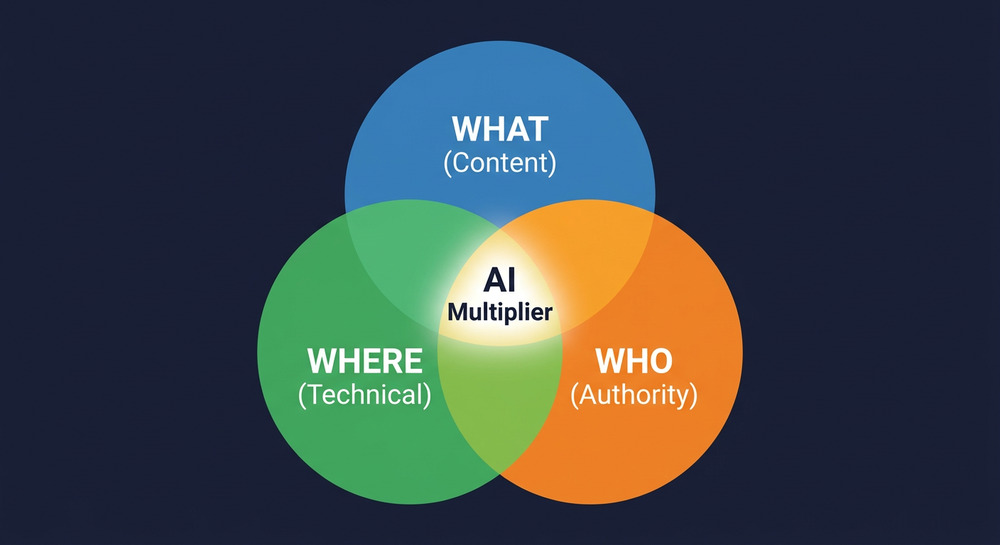
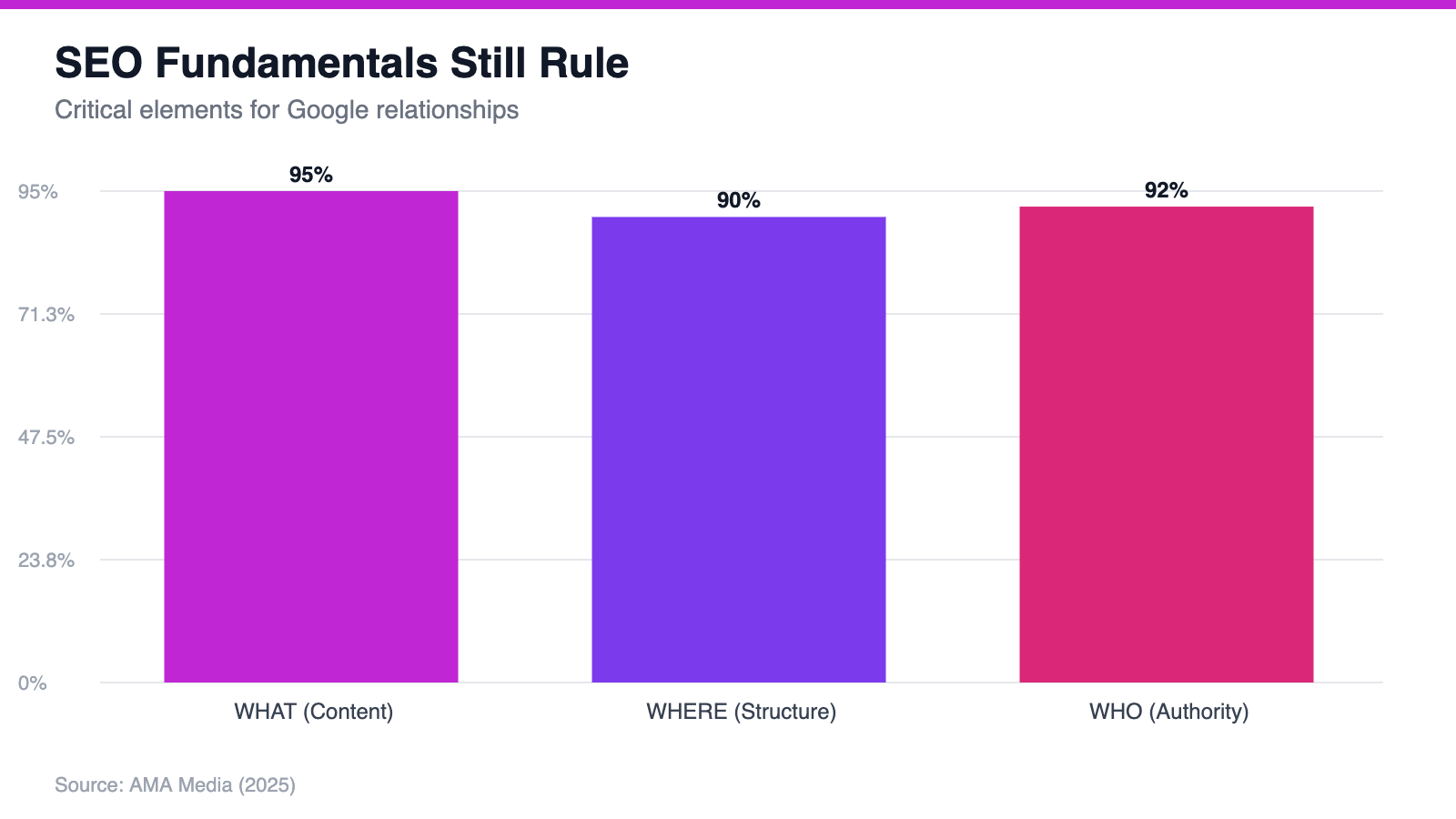
    Everyone expected AI to rewrite the SEO playbook from scratch. Instead, research from AMA Media delivered a counterintuitive finding: the foundational trinity of WHAT (your content substance), WHERE (technical placement and structure), and WHO (audience and authority) remains absolutely critical for Google relationships.

    This isn’t nostalgia—it’s algorithmic reality. AI tools can generate content at unprecedented scale and spot patterns humans would miss, but they still operate within search engine frameworks that prioritize relevance, authority, and user intent. The businesses that abandoned fundamentals for AI-only strategies? They’re discovering diminishing returns while hybrid operators see compounding benefits.

    Venn diagram showing the overlap of What, Where, and Who, with AI Multiplier in the center
    The fundamentals haven’t changed: Content, Technical structure, and Authority remain the core, but AI acts as the ultimate multiplier.
    SEO Fundamentals Still Rule
    SEO Fundamentals Still Rule — Source: AMA Media (2025)

    Notice the gap: AI amplifies good SEO practices but cannot compensate for poor ones. Think of AI as a multiplier—and anything multiplied by zero is still zero.

    The Numbers Don’t Lie: AI-Powered SEO Crushes Traditional Methods

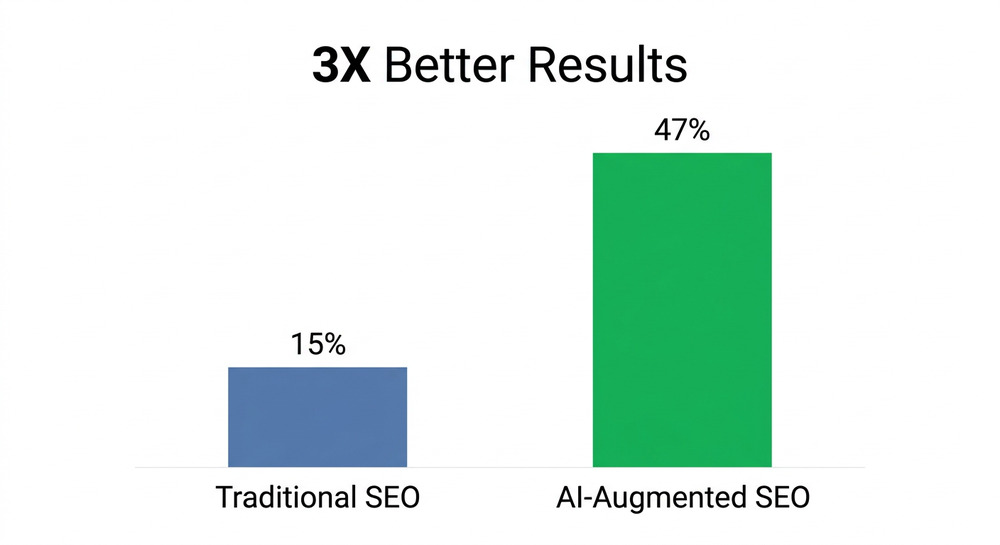
    Let’s talk performance. According to research published in the International Journal of Manuscripts, websites using AI-powered SEO tools see average ranking improvements of 23-47% within six months. Traditional optimization methods? A modest 8-15%.

    But here’s what the headlines miss: the variance in results has decreased dramatically. AI brings consistency to what was previously a wildly unpredictable process. You’re not just getting better outcomes—you’re getting more reliable ones.

    Bar chart comparing traditional SEO ranking improvements at fifteen percent to AI augmented SEO at forty-seven percent
    AI-powered tools offer up to 3x better ranking improvements over traditional manual optimization.
    AI-Powered vs Traditional SEO Results
    AI-Powered vs Traditional SEO Results — Source: AI-Powered SEO: Revolutionizing Digital Marketing (2024)

    The performance gap is stark, but so are the costs. Organizations report a 40% increase in tool expenses when implementing AI-SEO solutions, and 67% struggle with integration into existing workflows. The technology works—the organizational change management is the hard part.

    What AI-SEO Tools Actually Do Now

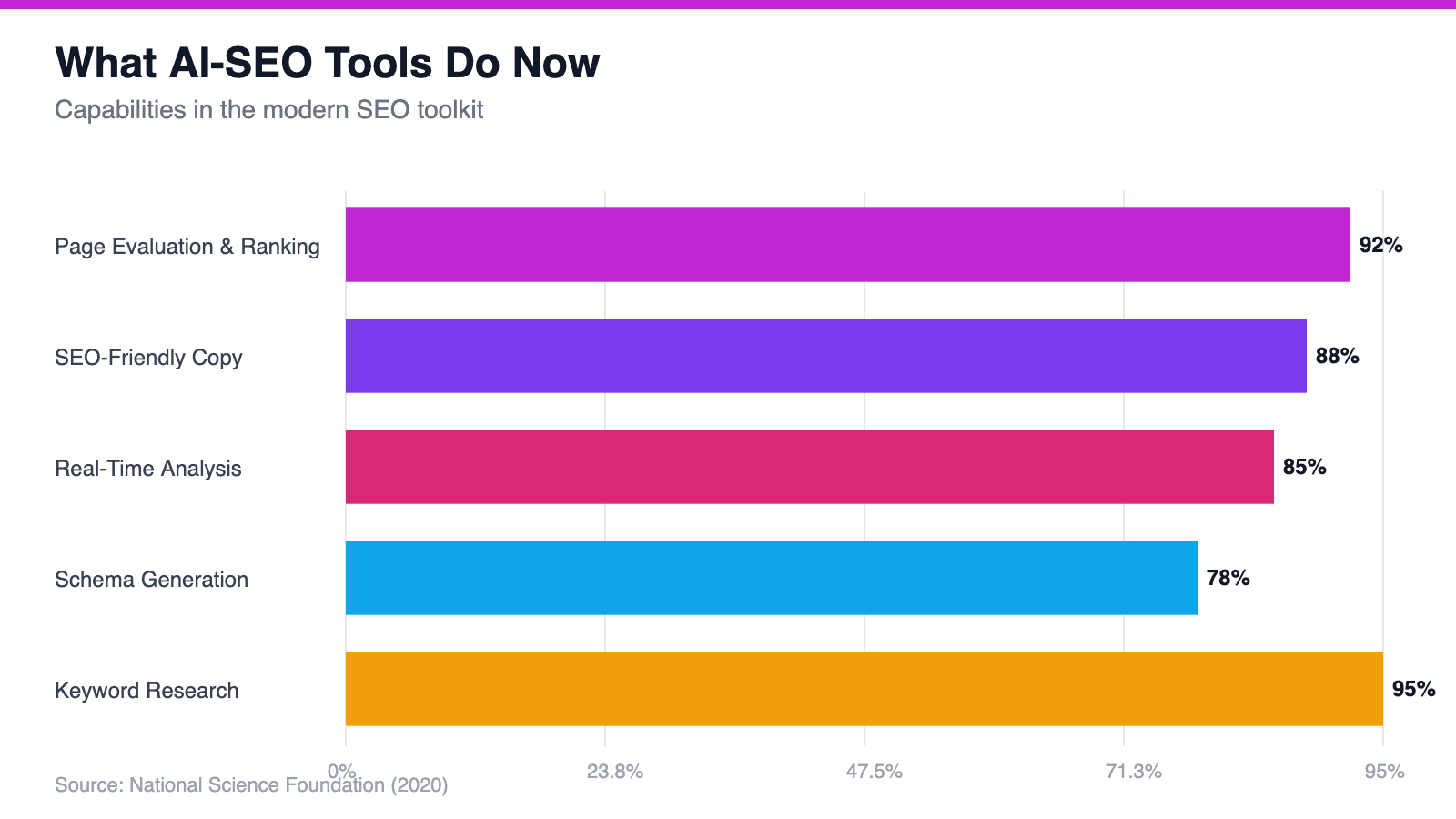
    The scope of AI-powered SEO has exploded. NSF data shows the SEO tools vertical now includes evaluation and ranking of site pages, writing SEO-friendly copy, and performing real-time analysis—all simultaneously. These aren’t incremental improvements; they’re capabilities that were impossible just two years ago.

    Modern AI tools can analyze millions of search patterns at once, predict algorithm changes before official announcements, and automatically adjust website elements in real-time based on performance data. Competitive SEO now requires AI augmentation not as a luxury, but as table stakes.

    What AI-SEO Tools Do Now
    What AI-SEO Tools Do Now — Source: National Science Foundation (2020)

    The transformation covers the entire SEO workflow—from predictive keyword research to automated schema markup generation. If you’re still doing this manually, you’re bringing a knife to a drone fight.

    Split infographic showing a sixty-seven percent donut chart for integration struggles and an upward graph showing forty percent tool cost increases
    While the performance benefits are clear, organizations face steep organizational and financial hurdles when adopting AI.

    The Weird New World: Search Engines That Don’t Crawl

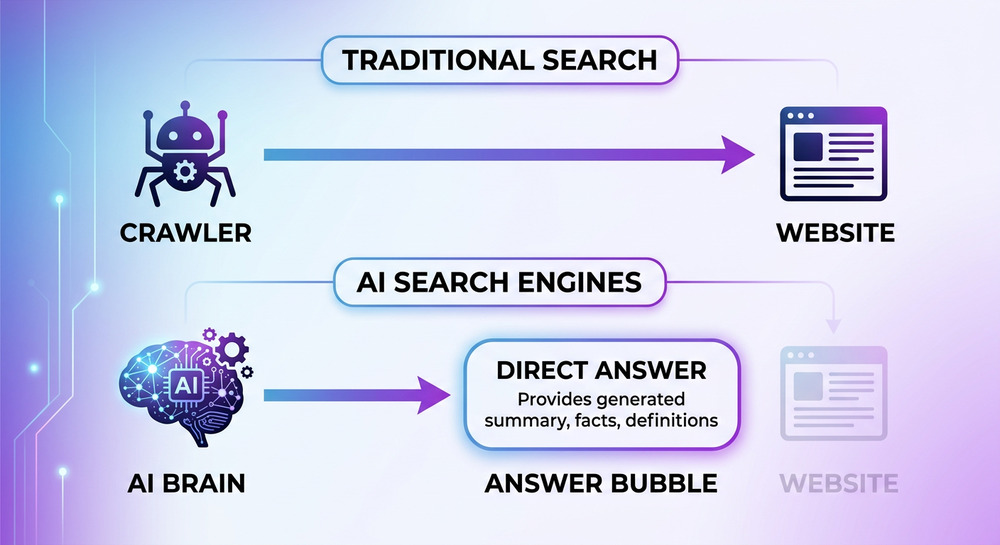
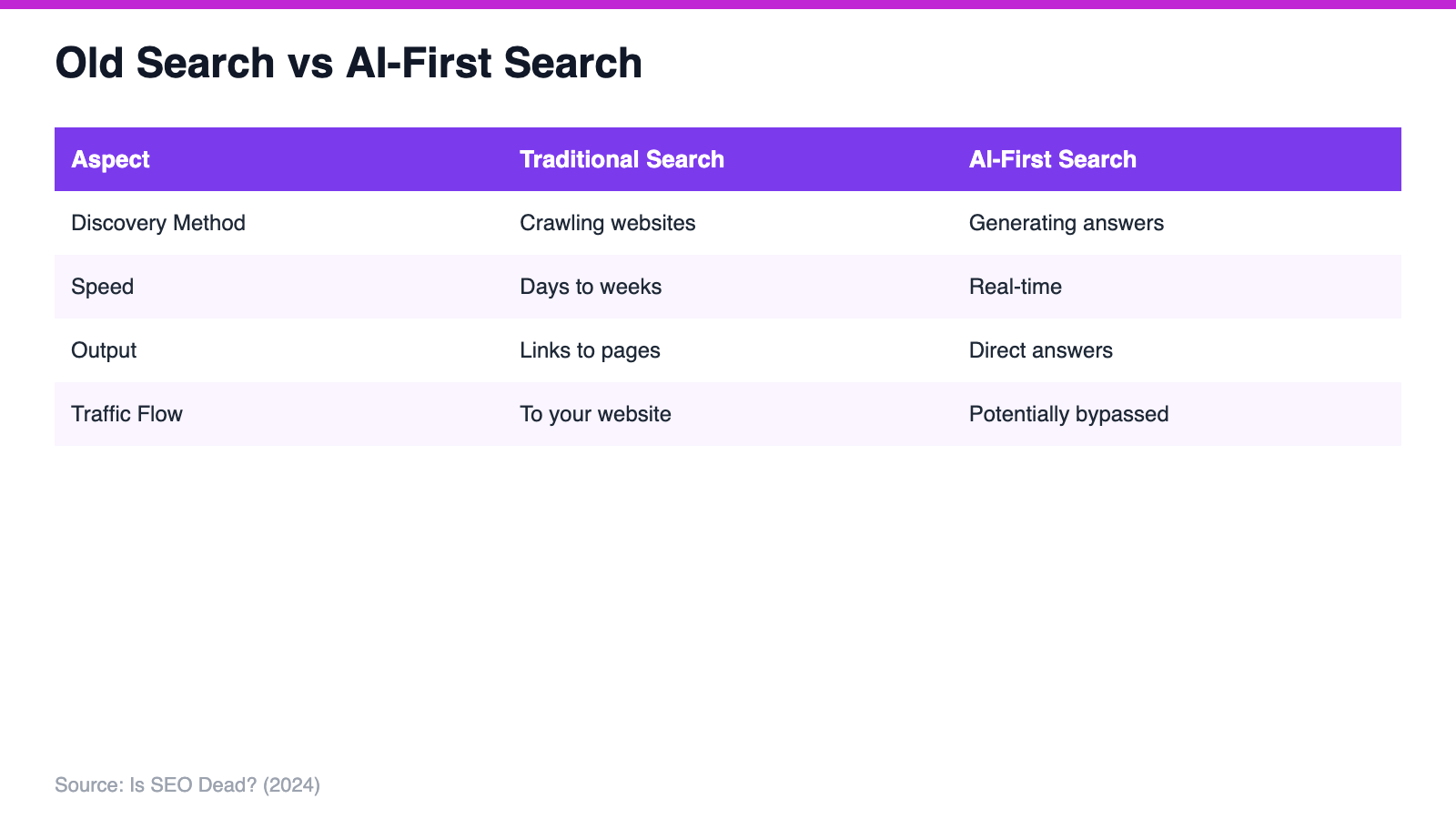
    Here’s where it gets genuinely strange. Research from Barry Rodgers points out something fundamental: new AI-based engines like ChatGPT and Google’s Gemini don’t have slow crawlers—they can create content directly. This fundamentally changes SEO dynamics.

    Traditional SEO relied on search engines crawling, indexing, and ranking existing content. AI-powered search engines can now generate answers directly, potentially bypassing your website entirely. The Australian Government Productivity Commission confirms this shift has “fundamentally altered the flow of online traffic.”

    Old Search vs AI-First Search
    Old Search vs AI-First Search — Source: Is SEO Dead? (2024)

    This isn’t theoretical anymore. The question isn’t whether to optimize for AI consumption—it’s how fast you can restructure your content strategy around it.

    Flowchart comparing traditional search engine crawling to AI search engines directly generating answers
    AI is fundamentally changing search dynamics: engines are moving from indexing existing content to generating their own answers.

    The Cannabis Industry Is Winning—And Here’s Why You Should Care

    Want to see AI-SEO at its most innovative? Look at the most regulated industries. Research shows AI has become a core component of digital marketing in the cannabis industry specifically for 2025 domination strategies.

    Cannabis businesses face unique nightmares: advertising restrictions, varying state regulations, and platform limitations that traditional SEO struggles to address. AI’s ability to identify compliant marketing opportunities while avoiding regulatory violations has proven transformative. The lesson for healthcare, financial services, and legal sectors? AI-SEO isn’t just for tech companies—it thrives in complexity.

    AI-SEO Implementation Reality
    AI-SEO Implementation Reality — Source: AI-Powered SEO: Revolutionizing Digital Marketing (2024)

    If heavily regulated industries can make AI-SEO work within strict compliance frameworks, your industry has no excuse.

    High Schools Are Teaching This Stuff Now

    Here’s a signal you shouldn’t ignore: SEO and AI ethics are becoming standard high school curriculum. Pennsylvania now requires SEO techniques in digital multimedia programs. California mandates students employ analysis and decision-making skills to ensure validity, credibility, and accuracy of AI-generated outputs. Ohio requires analysis of how AI technology impacts society. Michigan mandates assessment of new IT technologies including SEM and SEO.

    States Mandating SEO/AI in Education
    States Mandating SEO/AI in Education — Source: State Departments of Education (2024)

    This institutionalization means two things. First, SEO is no longer a specialized skill—it’s becoming fundamental literacy. Second, competitive advantage will shift from basic implementation to advanced strategy and creative application as foundational skills become commoditized.
    The Ethics Problem Nobody Wants to Talk About

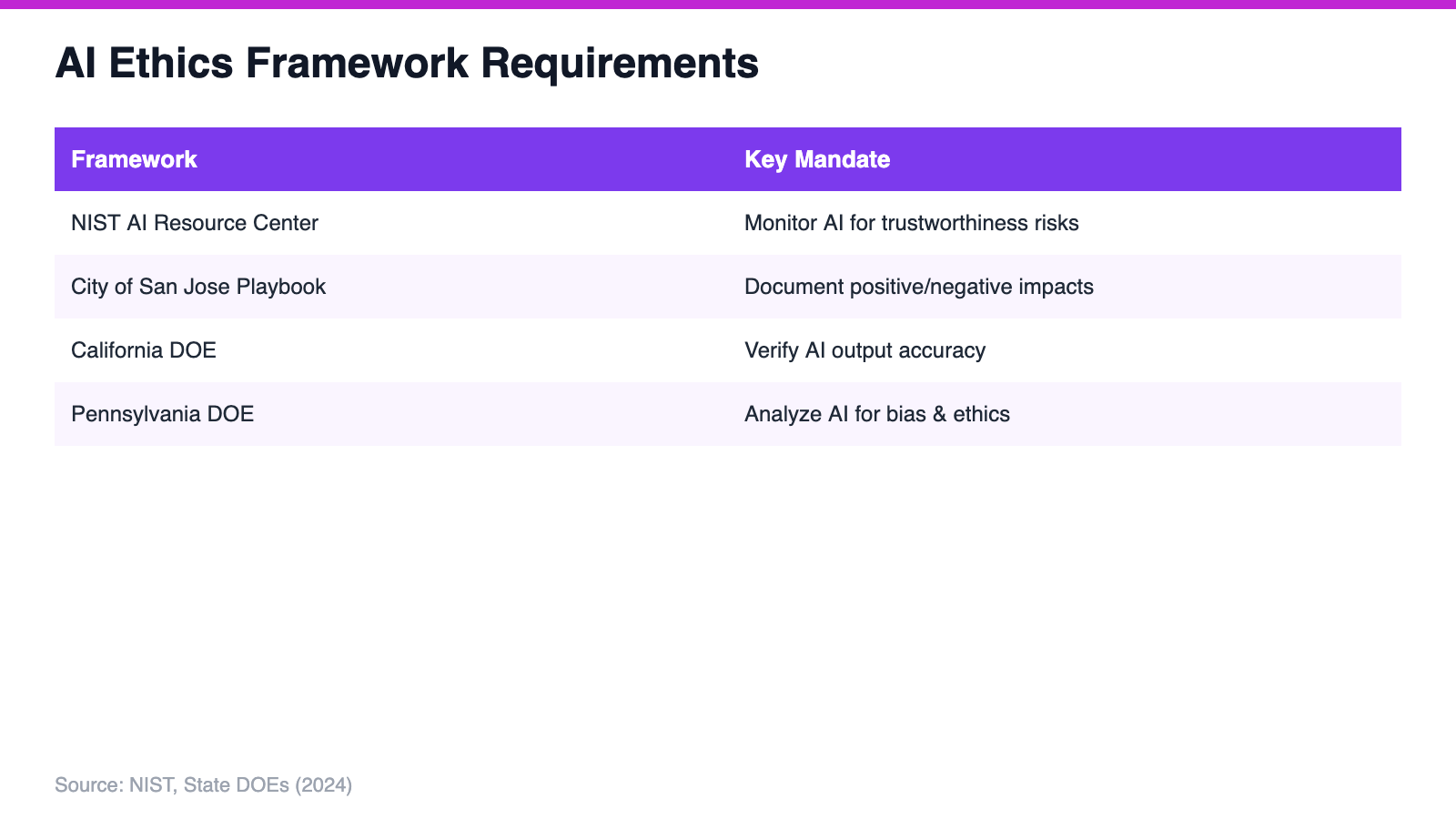
    With great AI power comes great responsibility—and emerging regulations. The NIST AI Resource Center framework now requires establishing procedures to monitor AI system performance for risks and negative/positive impacts on trustworthiness. The City of San Jose’s AI playbook documents that AI system impacts can be positive, negative, or both, based on organizational risk tolerances.
    Organizations must develop comprehensive ethical guidelines for AI use in SEO. This includes ensuring AI-generated content is accurate and unbiased, maintaining transparency about AI use, and preventing manipulative practices that could harm user trust. States are already mandating this in education—expect regulatory requirements for businesses to follow.

    AI Ethics Framework Requirements
    AI Ethics Framework Requirements — Source: NIST, State DOEs (2024)

    Building ethical frameworks now isn’t just good citizenship—it’s regulatory preparation.

    What This Means for You: The Action Plan

    The data is clear, but strategy without action is just daydreaming. Here’s your playbook for the AI-SEO convergence:

    Immediate Priorities (Next 90 Days)

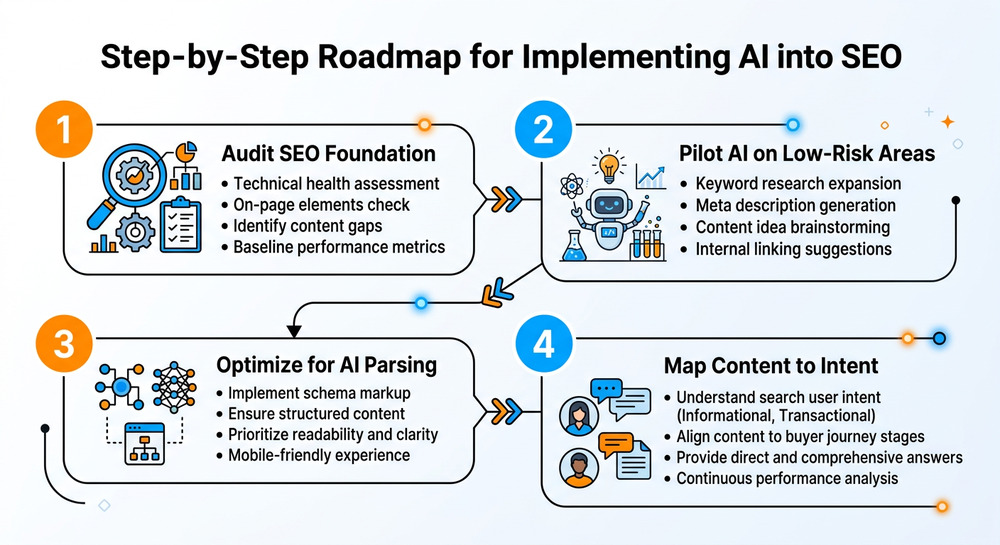
    • Audit your SEO foundation first: Before implementing AI tools, ensure your basic technical SEO, site structure, and content hierarchy are solid. AI multiplies quality—including the quality of your problems.
    • Pilot AI tools on low-risk, high-impact areas: Start with content optimization or technical auditing before expanding to complex applications.
    • Optimize for AI consumption: Structure content with clear headers, bullet points, and factual statements that AI can easily parse and reference when generating answers.
    • Map content to user intent: Create a comprehensive inventory mapped to specific intents. AI can scale this process, but the strategic framework must be human-designed.
    Four-step roadmap detailing the immediate priorities for AI SEO convergence
    Start your AI transition by securing your foundation before scaling up to complex, high-impact optimizations.

    Long-Term Strategic Shifts

    • Build AI-resistant competitive advantages: Develop unique data sources, proprietary insights, and human expertise that AI cannot easily replicate.
    • Create content ecosystems, not just pages: Design interconnected content systems that AI understands as comprehensive topic coverage.
    • Transition from traffic to engagement metrics: As AI changes traffic patterns, focus on metrics reflecting genuine user value rather than raw visitor numbers.
    • Build direct relationships: Develop email lists, app users, and direct traffic sources to reduce dependence on search engine referrals.
    The AI-SEO Bottom Line
    The AI-SEO Bottom Line — Source: Multiple Sources (2024-2025)

    The organizations that will win aren’t the ones with the most AI tools—they’re the ones that blend AI horsepower with human strategy, ethical guardrails, and foundational excellence.

    The Bottom Line

    AI hasn’t killed SEO. It’s made it faster, weirder, and significantly more powerful—but also more demanding. The fundamentals still matter, but executing them manually is now a competitive disadvantage. The winners in this new paradigm will successfully blend AI capabilities with human creativity, strategic thinking, and ethical responsibility.

    The question isn’t whether AI will continue transforming SEO—that’s already settled. The question is how quickly you can adapt your strategies, upskill your teams, and reimagine your approach to search visibility. Research, government frameworks, and educational initiatives all point to the same conclusion: AI-augmented SEO isn’t just the future—it’s the present reality demanding immediate action.

    References

    1. The Impact of AI on SEO: Technical Mechanics & User Behavior Shifts (2025). https://ww1.amamedia.org/wp-content/uploads/2025/11/The-Impact-of-AI-on-SEO_-Technical-Mechanics-User-Behavior-Shifts.pdf
    2. AI For SEO: A Dynamic Duo for Digital Marketing Success (2024). https://d3judojthu11zu.cloudfront.net/white-papers/AI+for+SEO.pdf
    3. The Algorithmic Ascent: AI’s Impact on Search Engine Result Pages (2025). https://ieeexplore.ieee.org/iel8/11051343/11051358/11051477.pdf
    4. AI-Generated Content in SEO and Content Marketing – JETIR (2024). https://www.jetir.org/papers/JETIR2401183.pdf
    5. AI + SEO: The Formula for Cannabis Industry Domination in 2025 (2025). https://spokesdigital.us/wp-content/uploads/2025/05/AI-SEO-The-Formula-for-Cannabis-Industry-Domination-in-2025.pdf
    6. AI-Powered SEO: Revolutionizing Digital Marketing (2024). https://s3.ap-southeast-1.wasabisys.com/ijmanuscripts/manuscripts/v10i6/V10I6-1374.pdf
    7. Leveraging Artificial Intelligence in SEO and SEM for Public Relations (2024). https://api.taylorfrancis.com/content/chapters/edit/download?identifierName=doi&identifierValue=10.4324/9781032671482-15&type=chapterpdf
    8. Is SEO Dead? Understanding the Future of Search in 2025 (2024). https://www.barryrodgers.com/wp-content/uploads/2024/11/Is-SEO-Dead_-Understanding-the-Future-of-Search-in-2025.pdf
    9. How AI is Transforming SEO: Opportunities and Challenges (2024). https://justpaste.it/hzr6f/pdf
    10. Australian Government Productivity Commission Document (2024). https://engage.pc.gov.au/document/2629
    11. Marketing & Sales – California Department of Education (2024). https://www.cde.ca.gov/ci/ct/sf/documents/ctemsmcs.docx
    12. Pennsylvania Career and Technical Education Task List (2024). https://www.pa.gov/content/dam/copapwp-pagov/en/education/documents/instruction/career-and-technical-education/programs-of-study/framework/task-list-27-28-29/110801-webpage-digital-multimedia.docx
    13. NIST AI Resource Center Google DeepMind Gap Analysis (2024). https://airc.nist.gov/docs/Template_Google_DeepMind_gap_analysis-NIST_AIRMF_1.0.xlsx
    14. IT Standards – Ohio Department of Education (2024). https://education.ohio.gov/getattachment/Topics/Career-Tech/Career-Fields/Information-Technology-Career-Field/Information-Technology-Course-Competencies-2.xlsx.aspx?lang=en-US
    15. Michigan Gap Analysis (2024). https://www.michigan.gov/mde/-/media/Project/Websites/mde/CTE/cte_cluster/Information-Technology/110801_Digital_Multimedia_and_Information_Resource_Design_Consolidated_2011_701901_7.xlsx
    16. City of San Jose CA AI Playbook (2024). https://airc.nist.gov/docs/City_of_San_Jose_CA_playbook.xlsx
    17. National Science Foundation Supplemental Tables (2020). https://ncses.nsf.gov/pubs/nsb20204/assets/supplemental-tables/tables/nsb20204-tabs08-063.xlsx
  • Hello world!

    Welcome to WordPress. This is your first post. Edit or delete it, then start writing!