Executive takeaway
Steam’s reported August 2026 rankings help identify headsets to compare, but cannot establish the best purchase. Quest 2 narrowly leads Quest 3, and Meta accounts for most connected headsets. Standalone-capable devices also dominate the reported mix, making them relevant to PC VR buyers. These shares do not measure comfort, image quality, reliability, or value at current prices. Choose around your games, playing setup, documented support, and complete costs. Treat broader XR growth separately: rising smart-glasses shipments do not establish rising demand for VR gaming headsets.
Start with what Steam actually measures
Can popularity identify the best VR headset to buy in 2026? Steam’s rankings answer a narrower question: which headsets appear in its hardware survey?
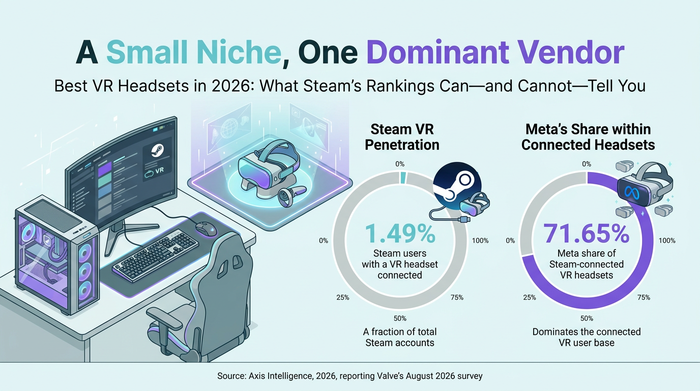
According to the supplied summary of Axis Intelligence’s account of Valve’s survey, 1.49% of Steam users had a VR headset connected in August 2026. Meta represented 71.65% of those connected headsets, not 71.65% of all Steam users. The first figure describes headset presence across Steam; the second describes Meta’s share within that smaller group.
A dominant vendor share can therefore describe a small corner of a larger platform. These figures establish Meta’s prominence among reported Steam-connected headsets, not across all gaming hardware or worldwide VR activity. Neither the original survey nor the cited article’s full text was available for independent inspection.
Treat the results as a platform-specific hardware snapshot, not a sales chart or engagement report. They do not count purchases, playing sessions, or hours spent in games. Meta’s share cannot support a claim that nearly three-quarters of Steam VR sessions use its hardware.
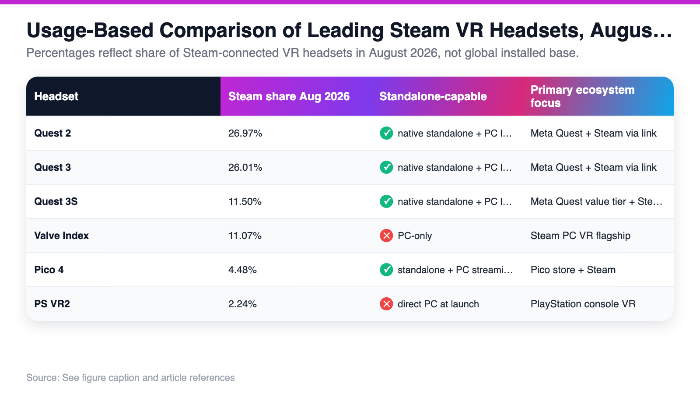
The model rankings sharpen the buying question without resolving it. Axis Intelligence reports Quest 2 at 26.97%, narrowly ahead of Quest 3 at 26.01%. That ordering describes their reported presence, not their relative quality or value today.
An older headset’s lead could reflect accumulated ownership rather than stronger appeal to new buyers. The snapshot cannot separate that explanation from price, preferences, or other reasons people retain hardware. It also does not assess comfort, visual clarity, tracking, or connection reliability.
Popularity is therefore a shortlisting signal, not a product verdict. Use the rankings to identify comparison candidates, then seek current specifications and independent testing. A widely used headset may deserve consideration without being the right purchase for you.
Why a PC headset no longer has to be PC-only
A headset used for PC VR need not depend entirely on a computer. Standalone-capable models have onboard processing that runs compatible software without a PC. Quest models and Pico 4 can also connect to a computer for PC VR.
A PC-native headset instead relies on a computer to run its VR software. Valve Index belongs to this category and offers no standalone mode. The distinction concerns how a headset operates, not which design necessarily performs better.
Axis Intelligence’s reported August 2026 breakdown assigns 71.99% of Steam-connected headsets to the standalone-capable category. This describes hardware capabilities, not purchase motivations or time spent in each mode. An owner using a standalone-capable headset exclusively for PC VR would still fall within that category.
The potential advantage is flexibility: one headset offers two ways to play. Owners can run compatible standalone software independently and connect to a suitable computer for PC titles. However, the survey does not establish how often owners use both modes—or whether flexibility drove their purchases.
Dedicated PC hardware makes a different proposition. If your preferred games already require a computer, the absence of standalone play may matter little. An extra mode adds value only if it serves your needs.
Before treating optional PC access as an advantage, check three requirements:
- Connection quality: Verify supported connection methods and investigate performance in a setup like yours. Do not assume wired and wireless arrangements provide equivalent experiences.
- Computer requirements: Check both the headset’s connection requirements and your intended games’ requirements. Standalone capability does not remove the computer’s workload during PC VR.
- Software access: Verify your preferred games in each mode. Two ways to play do not imply identical libraries or interchangeable purchases.
The reported mix supports including standalone-capable devices in a PC VR comparison. It does not establish that they outperform dedicated PC headsets.
Six headsets worth comparing, without crowning a false winner
These six headsets provide a starting comparison list, not a descending purchase order. The main distinction is between standalone-plus-PC options, dedicated PC hardware, and alternatives requiring individual setup checks.
All percentages below come from Axis Intelligence’s reported August 2026 breakdown. They describe shares of Steam-connected headsets, not comparative performance or value.
Quest models: standalone-plus-PC candidates
- Quest 2 — 26.97%. Its lead establishes continued presence in the reported mix, not superior value for a new buyer. Check current pricing, software access, and support before considering a purchase.
- Quest 3 — 26.01%. Its close position behind Quest 2 provides little basis for choosing between them. Compare verified features and testing against your intended use rather than treating second place as second best.
- Quest 3S — 11.50%. This offers another Quest option for standalone and PC play. Its share alone cannot establish a budget recommendation without current prices and a feature comparison.
Quest 2 leads Quest 3 by 0.96 percentage points, calculated from the reported shares. Existing ownership and replacement cycles could explain some persistence, but the evidence does not measure those causes. It also provides no uncertainty estimates for interpreting the narrow gap.
Buying and upgrading are different decisions. A large existing Quest 2 audience does not establish whether newcomers should buy one or owners should replace it. Both questions require evidence about the alternatives’ benefits and costs.
Valve Index: the PC-only candidate
- Valve Index — 11.07%. Consider Index when PC-only use matches your plans. Its share does not establish superior simulation performance, integration, optics, or comfort.
Index’s presence shows that dedicated PC hardware remains part of the reported mix. Continued use does not demonstrate that either hardware category delivers a better experience for every player.
Pico 4 and PS VR2: alternatives to check individually
- Pico 4 — 4.48%. Pico 4 provides a standalone-capable option outside the Quest lineup. Verify your intended games, connection method, regional availability, and setup requirements.
- PS VR2 — 2.24%. Its reported Steam presence makes it relevant to a PC VR comparison. Check required connection hardware and supported features rather than assuming every desired function carries over.
Smaller headset shares do not establish smaller multiplayer communities. Model shares neither count players in particular games nor reveal cross-platform compatibility. They also cannot establish which devices receive the best connectivity support.
A popular platform still deserves scrutiny
Meta’s prominence warrants platform scrutiny, not an assumption of better support. Its reported 71.65% share of Steam-connected headsets in August 2026 establishes concentration within this snapshot. Axis Intelligence’s figures do not measure update reliability, customer service, or product longevity.
A large hardware audience may encourage developers to test common configurations. That is a plausible incentive, not a demonstrated benefit in the supplied data. Compatibility and support must still be checked for the specific headset and software.
The supplied Quantumrun ecosystem summary describes access to Quest’s standalone library and PC VR through a connected computer. This expands possible software access, but access across stores does not imply ownership across stores. Buying one version does not, on this evidence, establish entitlement to another.
Check purchase entitlements—the versions a purchase lets you use—through store listings and publisher terms. Do not assume games, downloadable content, or saved progress transfer between platforms.
Before committing to an ecosystem, investigate three areas:
- Accounts: Check setup and purchasing requirements, account-recovery procedures, and household restrictions. Establish which functions depend on each account.
- Store policies: Verify refunds, subscriptions, and access to purchased content. Check cross-buy explicitly: it means one purchase includes versions for more than one platform.
- Ongoing support: Seek model-specific information about software updates, repairs, replacement controllers, and warranty coverage. Overall vendor popularity is not a support commitment.
Platform dependence is a potential risk, not evidence of imminent decline. Essential games or functions may depend on a vendor’s continuing services and policies. That warrants examining dependencies, not predicting abandonment or assuming a smaller vendor is safer.
The relevant question is whether a particular headset’s stores, accounts, and documented support fit your needs. Market leadership alone cannot answer it.
Why booming XR does not mean booming VR headset sales
Broader XR growth does not necessarily mean stronger VR headset sales. Extended reality, or XR, covers virtual, augmented, and mixed reality. Some market reports also include smart glasses within their device totals.
These categories serve different purposes, so their shipment trends can diverge. Growth in smart glasses cannot by itself establish increasing demand for immersive VR gaming hardware.
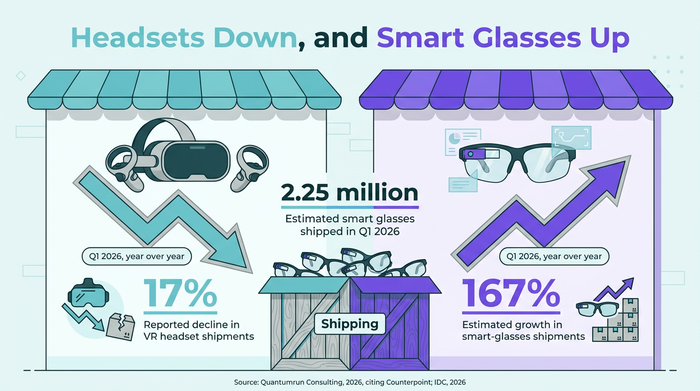
The supplied Quantumrun summary of Counterpoint data reports that VR headset shipments fell 17% in Q1 2026 compared with Q1 2025. Shipments measure newly supplied hardware, not continued use of devices bought previously.
By contrast, the supplied evidence attributes to IDC an estimated 167% increase in smart-glasses shipments in Q1 2026 compared with Q1 2025. Estimated shipments reached approximately 2.25 million units. This contrast illustrates why a strong XR headline may obscure weakness in VR headsets.
These estimates concern different product categories and source methods, not directly comparable market shares. They also do not isolate gaming-only purchases within headset shipments. Without aligned definitions and a common denominator, they cannot establish each category’s share of one market.
Falling shipments can coexist with continued use because new hardware supply and existing-device activity measure different things. Keeping a headset in use generates no replacement shipment. This resolves the apparent contradiction but does not establish whether overall VR activity rose or fell.
Revenue forecasts require a further distinction. Market estimates may include hardware, content, or services, depending on their scope. Forecast revenue growth therefore cannot substitute for observed shipment growth or active-player counts.
For buyers, separate market momentum from product usefulness. Smart-glasses growth proves neither that VR gaming is flourishing nor that glasses will replace it. A headset’s suitability still depends on its software, capabilities, support, and cost.
Choose for your games, your setup, and your budget
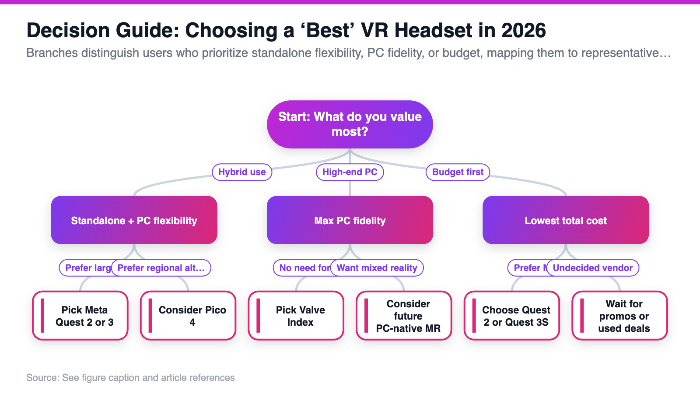
Start with your games, not the leaderboard. List your must-play titles, then decide whether playing without a PC matters. The following checks are recommended evaluation criteria, not findings from hands-on testing.
For standalone and PC play, compare Quest 2, Quest 3, Quest 3S, and Pico 4.
- Consider Valve Index when a PC-only setup fits your plans, and PS VR2 when its PC requirements suit you.
- These categories organize the comparison; they do not establish equal compatibility, value, or performance.
Work through the practical checks in this order:
-
Games and platform access. Confirm each must-play title supports your chosen headset and intended mode. Check purchase entitlements and account requirements rather than assuming one purchase covers standalone and PC versions.
-
PC requirements. Compare your computer against current requirements for both headset connectivity and intended games. Presence in Steam’s rankings does not establish satisfactory performance on your machine.
-
Connection options. Verify supported methods, required ports, and necessary cables, adapters, or network equipment. For wireless PC play, investigate recommended network arrangements before setting your budget.
-
Comfort and visual quality. Where possible, try the headset with your usual glasses and expected session length. Assess fit, readable text, image clarity, and adjustment rather than choosing from resolution alone.
-
Controllers and play space. Check game input requirements, available room, and any necessary tracking equipment. Evaluate whether the controls and physical setup suit how you play.
-
Complete setup cost. Include required accessories, connection hardware, games, and necessary PC upgrades. Compare complete usable setups, not one headset’s discounted price against another model’s full kit.
Already own a headset? Identify a specific limitation before upgrading. It might be uncomfortable fit, unreadable cockpit text, unreliable connectivity, or missing software access. Seek evidence that a replacement addresses that limitation; popularity cannot establish the improvement.
For any older model, verify current price, availability, and documented support, including replacement parts. A substantial existing audience does not establish how long a manufacturer will maintain the device.
Steam’s reported August 2026 rankings identify devices worth comparing, but leave the decisive buying questions open. Use them to build a shortlist, then eliminate products that fail your requirements. Popularity informs the comparison; suitability determines the purchase.
Limitations
-
The supplied evidence summarizes sources. Their full text and Valve’s original survey were not independently inspected.
-
Steam-connected headset shares are platform-specific, month-specific observations. They do not measure playtime, purchase intent, satisfaction, or global VR adoption.
-
The available evidence does not fully disclose sampling methods or uncertainty. Small differences between reported shares should not carry decisive buying weight.
-
No current prices, comparative hands-on tests, or verified support timelines establish an overall best headset.
-
Market reports use different categories and methods. Shipment estimates, revenue forecasts, and observed hardware presence measure different things.
Leave a Reply